
Two Lions Stopped a Railway by Eating the Workers Building It.
In 1898, a pair of maneless male lions terrorized British Uganda Railway construction camps in Tsavo, Kenya. Over nine months of nocturnal predatory attacks, the lions dragged dozens of Indian indentured laborers from their tents, repeatedly halting work on the railway bridge until engineer John Henry Patterson hunted them down.
In this dossier (8 chapters) ▾
- 01 A Railway Across British East Africa
- 02 Nine Months of Nocturnal Terror in the Camps
- 03 How Many People Did the Tsavo Lions Actually Eat?
- 04 December 1898: The Hunt and the Final Ambush
- 05 From Trophy Rugs to the Field Museum in Chicago
- 06 What the Record Shows
- 07 Archival Evidence & Picture Credits
- 08 Verified Archival Sources & Bibliography
Historical Dossier: The Man-Eaters of Tsavo Location: Tsavo River, British East Africa (now Kenya) | Year: 1898 | Key Figures: Lieutenant-Colonel John Henry Patterson, the railway workers, two male lions
A Railway Across British East Africa
In March 1898, British colonial engineers reached Mile 132 of the Uganda Railway—an ambitious 580-mile strategic rail line nicknamed the “Lunatic Express” by British parliamentarians, designed to link the Indian Ocean port of Mombasa (Kilindini Harbour) with the shores of Lake Victoria across the arid scrubland and Rift Valley escarpments of British East Africa (modern Kenya). At Tsavo, where the caravan trail crossed the palm-lined Tsavo River beneath scorching heat and dense Commiphora wait-a-bit thornbush, construction crews had to erect a permanent iron-girder railway bridge. Spread out along an eight-mile stretch of the river valley were dozens of canvas tent camps housing roughly three thousand Indian indentured labourers (coolies), Punjabi artisans, and Sikh guards recruited from British India, alongside African porters and British railway officials.
On 1 March 1898, thirty-year-old Lieutenant-Colonel John Henry Patterson—an Irish-born Protestant engineer and former British Indian Army officer from County Longford—arrived at Tsavo from Mombasa to take command of the permanent bridge works. Within days of his arrival in the thornbush, men began vanishing from their tents in the middle of the night.
Nine Months of Nocturnal Terror in the Camps
At first, when two Indian workmen disappeared from their tents, Patterson suspected foul play by fellow labourers looking to steal their savings. Then, one morning shortly after dawn, a popular Sikh jemadar (corporal) named Ungan Singh—a towering, bearded veteran who shared a tent with five other men—was dragged screaming by the throat out from beneath his canvas flap by a huge lion. Following the trail of blood and torn cloth into the thorn scrub at daybreak, Patterson and Captain Haslem found nothing left of Singh except his skull and fingers, with the dual pugmarks of two large adult male lions circled around the spot.
Like many male lions native to the hot, low-elevation Tsavo basin, neither predator grew the heavy flowing mane characteristic of Serengeti lions—an adaptation linked to extreme daytime heat, water stress, and dense thorny undergrowth. Over a nine-month reign of terror from March to December 1898, the two maneless brothers stalked the railway camps with chilling boldness. To protect themselves, the labourers piled massive circular ramparts of razor-sharp boma thorn hedges around every tent, kept huge bonfires blazing through the night, and clanged empty kerosene tins together whenever a roar echoed across the river. Yet the lions leaped straight over or forced their way through the thorn fences, ignored the fires, and dragged victims out of hospital tents and railway goods wagons. At first they hunted singly; later, as Patterson wrote in his 1907 memoir The Man-Eaters of Tsavo, they “became more brazen, entering together and each seizing a victim.”
By early December 1898, terror brought bridge construction to a standstill for nearly three weeks. Convinced that the two beasts were not ordinary animals but the reincarnated spirits of angry African chiefs determined to stop the iron road, hundreds of Indian workers flagged down a passing Down-train by throwing themselves across the tracks and fled back toward the coast, leaving Patterson with only a handful of resolute men sleeping atop water tanks, masonry piers, and tree branches.
How Many People Did the Tsavo Lions Actually Eat?
In his bestselling 1907 book The Man-Eaters of Tsavo and later public lectures, Patterson stated that the two lions killed 135 Indian and African railway workers (while British Prime Minister Lord Salisbury cited 28 Indian and “scores of unfortunate Africans” in an address to the House of Lords). Over the past twenty-five years, zoologists, anthropologists, and museum curators have subjected that number to rigorous forensic testing:
- Archival Journal Review (2001): Historians Bruce Patterson and Julian Kerbis Peterhans examined Patterson’s original handwritten field journals and Uganda Railway dispatches, concluding that 28 to 31 deaths among registered Indian employees were formally documented, while noting that deaths among unregistered local African workers and caravan porters went largely uncounted by railway clerks.
- Stable Carbon and Nitrogen Isotope Analysis (2009): Researchers from the University of California, Santa Cruz, and the Field Museum analyzed collagen from the lions’ bone and hair samples—which preserve dietary signatures from the final two to three months of the animals’ lives. Published in the Proceedings of the National Academy of Sciences (PNAS), the study calculated that the first lion (FMNH 23970) consumed the equivalent of roughly 24.2 humans and the second lion (FMNH 23969) consumed roughly 10.5 humans—yielding a scientifically verified estimate of approximately 35 humans eaten (with statistical bounds ranging from 4 to 72, excluding victims killed but not fully consumed).
- Dental Pathology and 2017/2024 Forensic Studies: In 2017, paleobiologist Larisa DeSantis and Bruce Patterson published high-resolution dental microwear and CT analyses in Scientific Reports, revealing that the primary man-eater (FMNH 23970) suffered from a broken lower canine tooth and a severe root-tip abscess that made clamping the windpipe of struggling Cape buffalo or zebra excruciatingly painful—driving the lion toward soft-bodied human prey after the 1890s rinderpest cattle plague and severe drought depleted Tsavo’s wild herds. In 2024, ancient DNA extracted from compacted hairs inside those broken tooth cavities confirmed that the two lions were maternally related brothers who had fed on human, giraffe, oryx, waterbuck, wildebeest, and zebra.
December 1898: The Hunt and the Final Ambush
For months, every trap Patterson devised ended in humiliation. On one occasion, he rigged a heavy railcar trap split into two compartments—one holding three armed marksmen and the other acting as a drop-gate cage. A lion walked directly into the cage, tripping the iron bar shut, but the panicked gunmen fired wildly at point-blank range, failing to hit the cat and instead shooting away the padlock holding the side door, allowing the lion to burst free into the night.
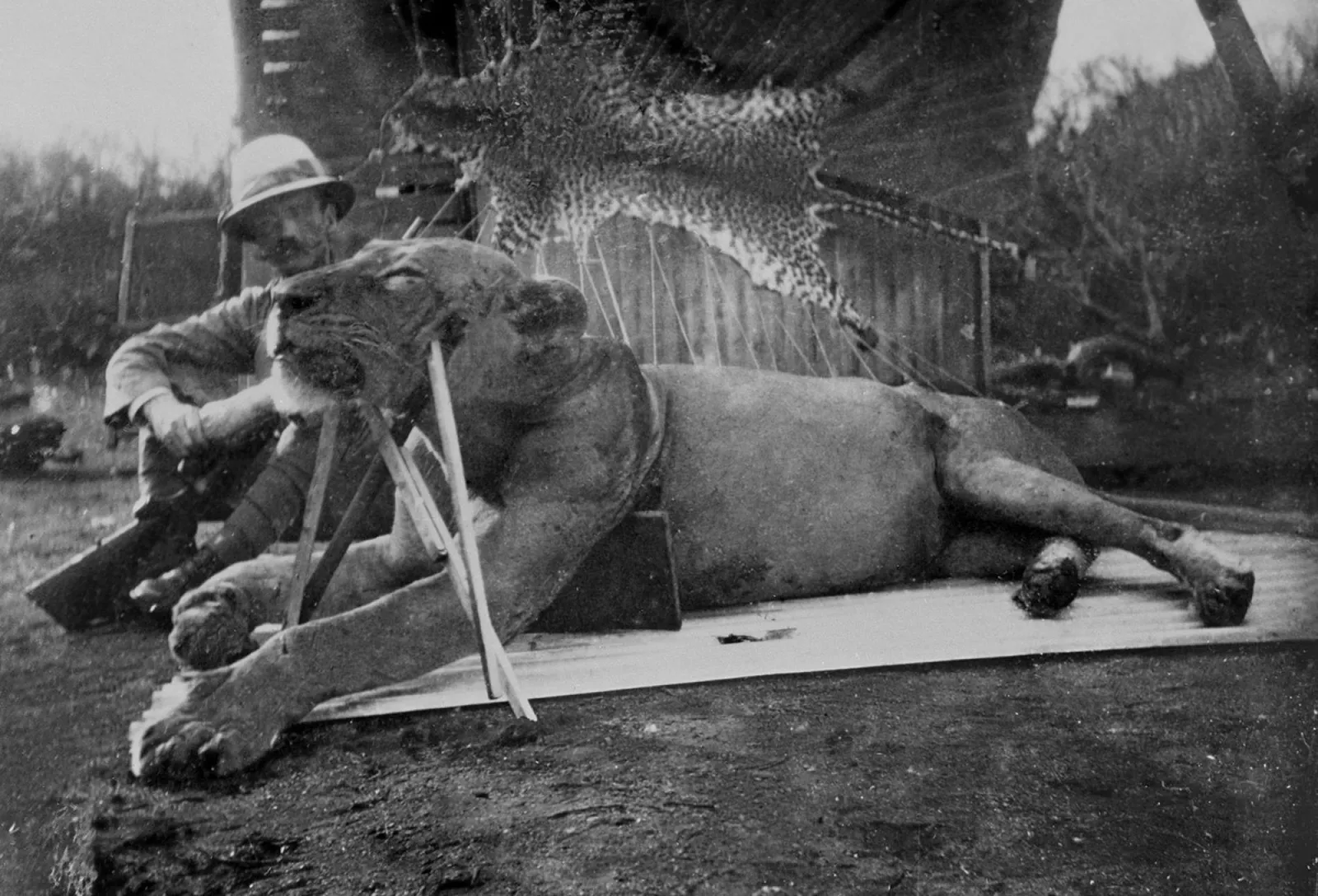
The turning point came on the night of 9 December 1898. Summoned to a camp where a lion had just killed a donkey and chased off its driver, Patterson climbed onto a precarious twelve-foot wooden Machan (scaffolding platform) built of four poles beside the carcass, armed with a borrowed .303 Lee-Enfield rifle and a double-barrelled smoothbore 12-bore shotgun loaded with lead slugs. As the moonless night deepened, the larger man-eater crept back through the bush, circling the platform rather than the donkey. Just as the lion crouched to spring directly at Patterson’s perch, he fired both barrels. After a frantic nocturnal battle in which the platform nearly collapsed, searchers at dawn found the first man-eater dead in the thicket—measuring nine feet, eight inches from nose to tip of tail and requiring eight men to carry back to camp.
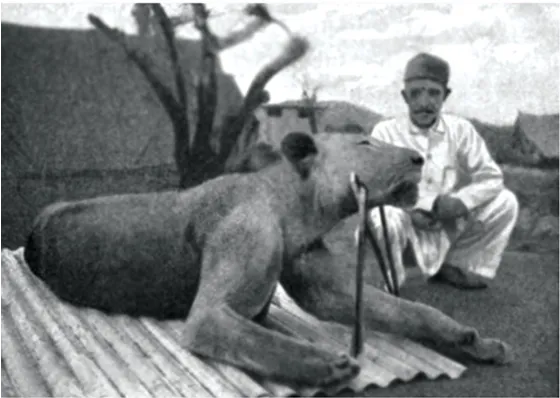
Twenty days later, after the surviving brother returned to attack the railway inspector’s bungalow, Patterson wounded it from a scaffolding on the night of 28 December and tracked its blood trail the following morning, 29 December 1898. Cornered in the bush, the wounded predator charged Patterson furiously despite absorbing multiple .303 and Martini-Henry bullets, forcing Patterson to scramble into the branches of a tree before delivering the fatal shots to the chest and head. In all, the second lion absorbed between six and nine bullets before dying.
From Trophy Rugs to the Field Museum in Chicago
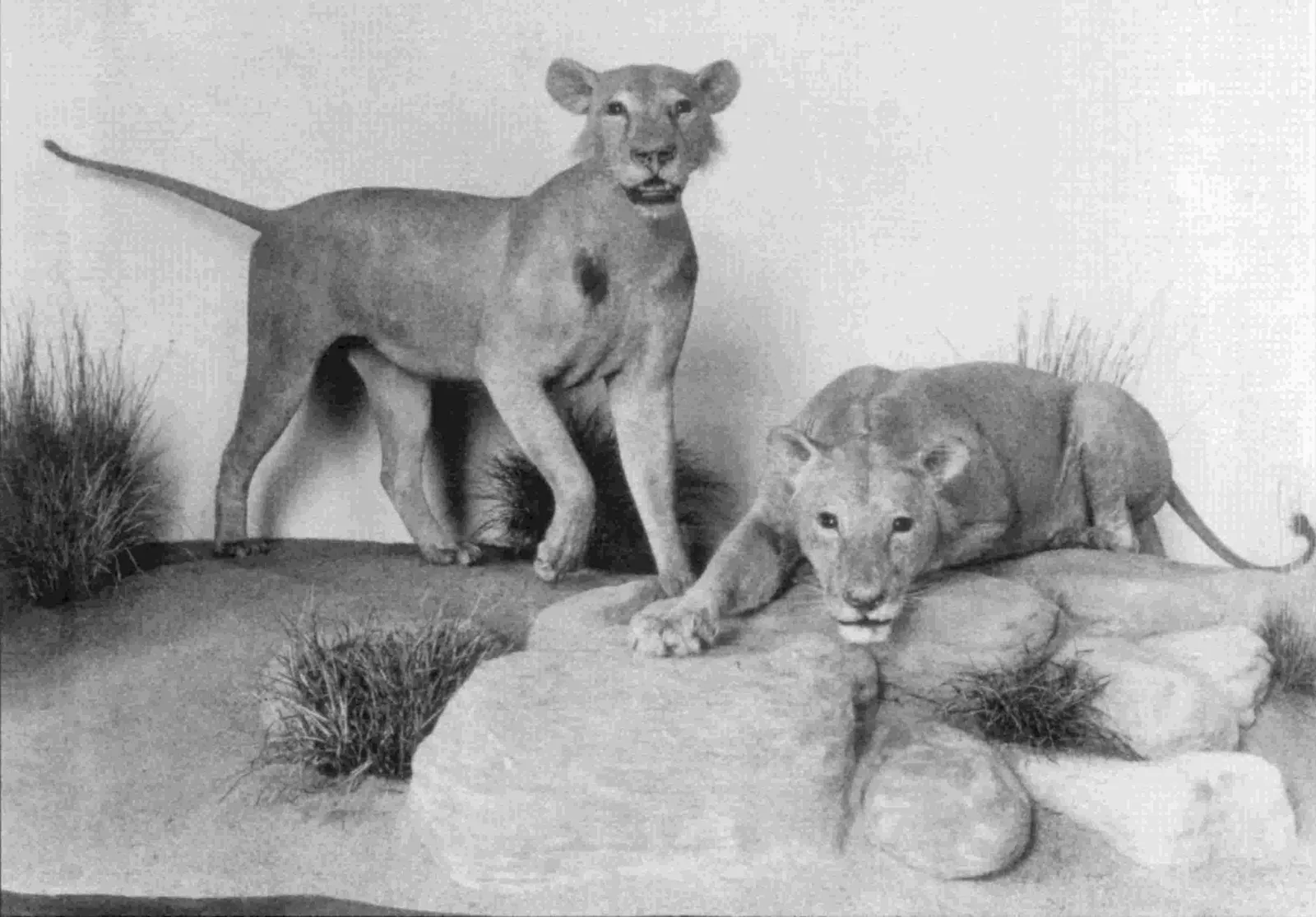
With both man-eaters dead, the terrorized workforce returned to Tsavo in January 1899 and completed the permanent multi-span Tsavo River railway bridge on 7 February 1899, presenting Patterson with an inscribed silver bowl in gratitude. For twenty-five years, Patterson kept the two lion skins spread across the floor of his study as trophy rugs. In 1924, while lecturing in Chicago, he sold both skins and skulls to the Field Museum of Natural History for $5,000. Restored and mounted by master taxidermist Julius Friesser (leaving the skins noticeably smaller than in life because the borders had been trimmed for floor rugs), the Tsavo Man-Eaters remain on permanent public exhibition in Chicago—where modern genetics and isotope chemistry continue to unlock the secrets of their 1898 rampage.
What the Record Shows
8 sourced claims in this story, resting on 4 primary and historical records. Numbers link to the bibliography below.
- Two maneless male lions preyed on railroad workers building the Uganda Railway at Tsavo in 1898 - sources: 4
- Construction was halted for nearly a month as hundreds of Indian laborers refused to work - sources: 2
- Engineer Lt. Col. John Henry Patterson shot both lions in December 1898 - sources: 2, 4
- Patterson sold the lion skins and skulls to the Field Museum of Natural History in Chicago in 1924 - sources: 2, 3
- Stable isotope analysis in 2009 scientifically verified that the lions consumed approximately 35 humans - sources: 3
- Dental pathology examinations revealed severe jaw injuries and broken canine teeth that impaired hunting buffalo - sources: 5
- Tsavo lions typically lack manes due to extreme regional heat and thorn-dense scrub ecology - sources: 3, 4
- The lions’ taxidermy mounts remain one of the Field Museum’s most celebrated zoological exhibits - sources: 3, 4
Archival Evidence & Picture Credits
Every image on this page was checked against its Wikimedia Commons file page.
- Lieutenant Colonel John Henry Patterson with one of the Tsavo lions he shot (Wikimedia Commons) - Wikimedia Commons file page
- The second man-eating lion shot by Patterson (Wikimedia Commons) - Wikimedia Commons file page
- The mounted Tsavo man-eaters on display at the Field Museum in Chicago (Wikimedia Commons) - Wikimedia Commons file page


Verified Archival Sources & Bibliography
Every claim in this account has been fact-checked against primary archives and scholarly repositories:
- Internet Archive: The Man-Eaters of Tsavo (Lt. Col. J. H. Patterson) (primary)
- Field Museum of Natural History (Chicago): The True Story of the Tsavo Lions (primary)
- Wikipedia: Tsavo Man-Eaters (reference)
- Scientific Reports: Dental pathology and prey choice in the Tsavo man-eaters (academic)
Historical Connection Graph
The Ship That Rescued the Titanic Survivors Met a Deadlier Fate.
AJ. "Two Lions Stopped a Railway by Eating the Workers Building It.." Echoes of History Uncut. Last modified September 15, 2026. https://echoesofhistoryuncut.com/articles/tsavo-man-eaters/.

An independent digital history publication and documentary studio reconstructing historical turning points through primary archives, official inquiries, and scholarly citations. Every factual claim in this dossier is cross-referenced to the numbered bibliography above.