
Six Men Died Building This Tunnel Under the River Thames
Begun in January 1825 to link the Port of London with Rotherhithe beneath the River Thames, the Thames Tunnel pioneered Marc Brunel's cast-iron tunneling shield while young Isambard Kingdom Brunel nearly drowned in river floods. Opened to pedestrians in 1843 and sold to the East London Railway in 1865, it still carries London trains beneath the river today.
In this dossier (8 chapters) ▾
- 01 A Subterranean Road Beneath the Port of London
- 02 Marc Brunel’s Revolutionary Tunnel Shield
- 03 The Underwater Banquet and the Fancy Fairs
- 04 From Victorian Footpath to London Railway
- 05 Why It Matters
- 06 What the Record Shows
- 07 Archival Evidence & Picture Credits
- 08 Verified Archival Sources & Bibliography
Historical Dossier: The Construction of the Thames Tunnel Location: Rotherhithe to Wapping, River Thames, London | Year: 1825–1843 (Converted to Rail 1871) | Key Figures: Sir Marc Isambard Brunel, Isambard Kingdom Brunel
A Subterranean Road Beneath the Port of London
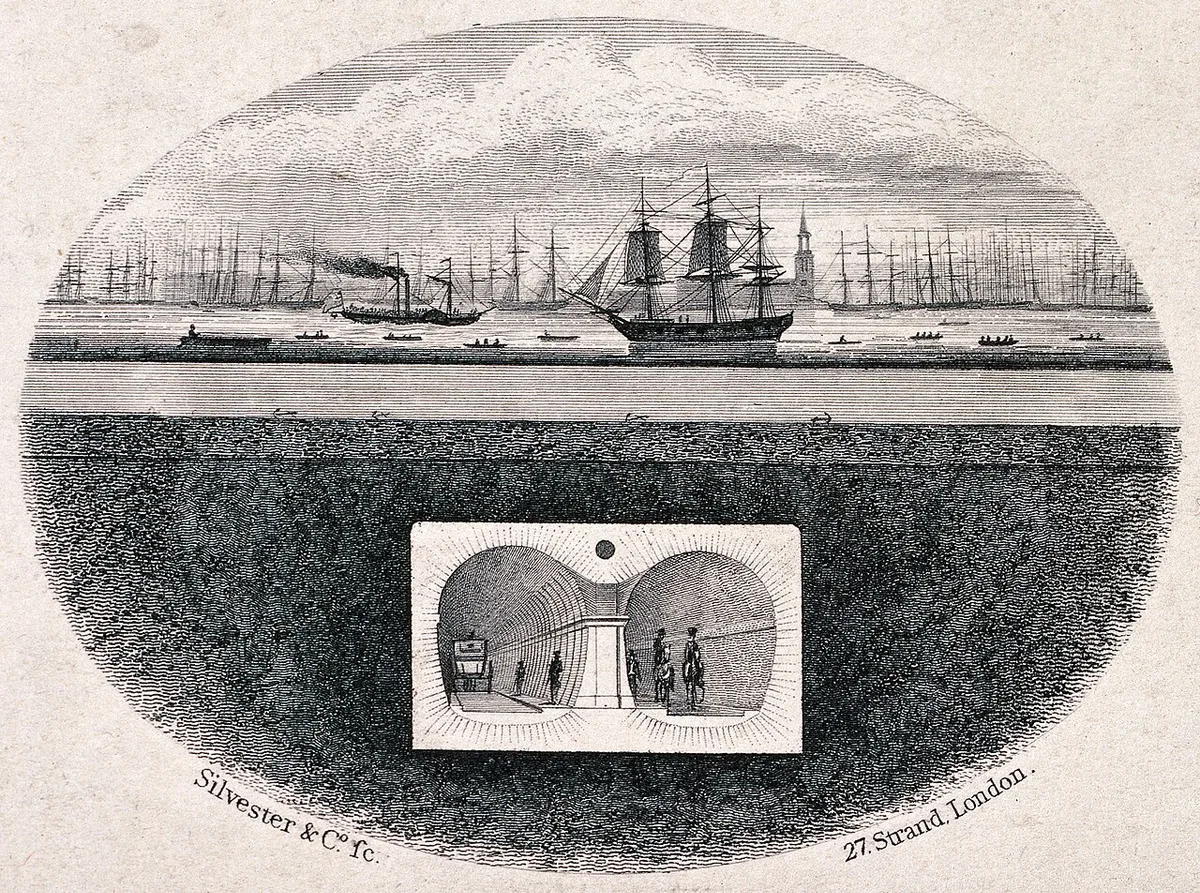
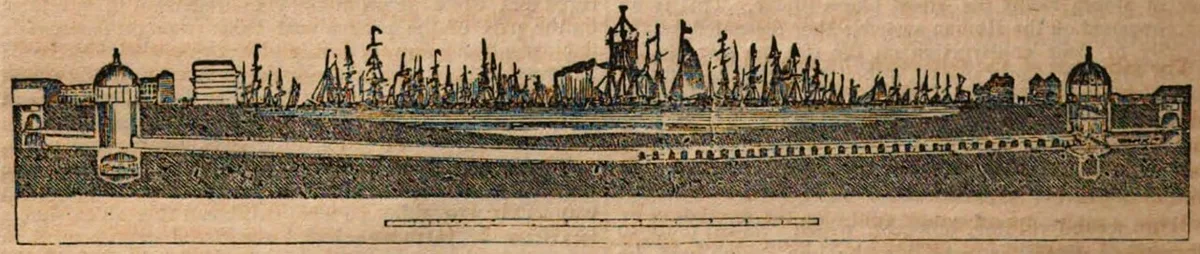
In January 1825, work began at Rotherhithe on an audacious engineering venture that no civilization had ever successfully completed: driving a permanent brick-lined carriageway directly beneath a major navigable river. By the early nineteenth century, the Port of London had become the busiest maritime trade hub on Earth, with thousands of tall-masted merchant vessels crowding the Thames east of London Bridge. Because high-masted ships could not pass beneath low masonry bridges, carts and dockworkers traveling between Wapping on the north bank and Rotherhithe on the south bank faced hours of gridlock. The Thames Tunnel Company was formed to solve that bottleneck by boring a twin-arched subterranean thoroughfare 1,300 feet long and 75 feet beneath the high-water mark of the river.
Every previous attempt to tunnel through the soft, waterlogged alluvial clay, silt, and quicksand beneath the Thames—including Richard Trevithick’s narrow driftway of 1807—had ended in catastrophic collapse when the river broke through the roof. To succeed where earlier miners had failed, the project brought together engineers and laborers from across Great Britain, Ireland, and continental Europe, led by a remarkable father-and-son team of French-born and British-trained engineers: fifty-five-year-old Sir Marc Isambard Brunel and his nineteen-year-old son, Isambard Kingdom Brunel.
Marc Brunel’s Revolutionary Tunnel Shield
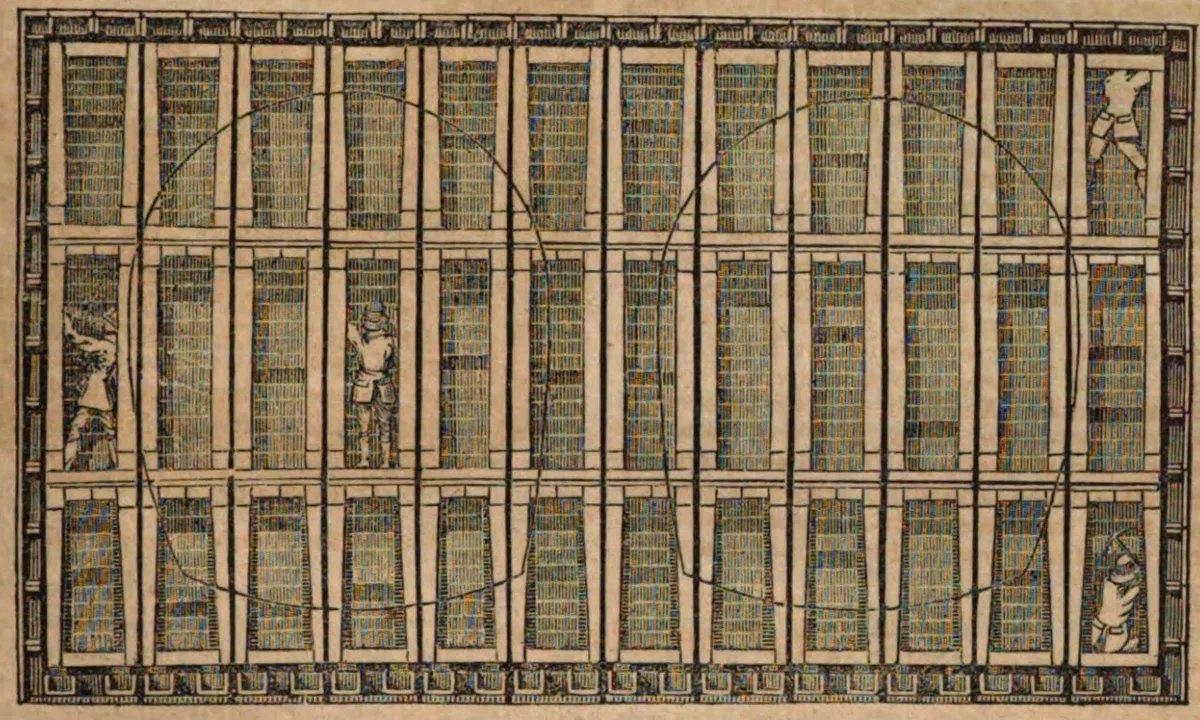
Inspired by observing how the shipworm (Teredo navalis) bores through submerged timber while lining its burrow with a protective calcareous shell, Marc Brunel patented a revolutionary cast-iron tunneling shield in 1818. Weighing over eighty tons and standing three stories tall, the iron frame was divided into thirty-six individual cells across twelve vertical frames. Inside each cell, a miner removed a single wooden poling board at a time, excavated four inches of soft riverbed clay ahead, braced the board back against the face, and used screw jacks to push the iron shield forward while bricklayers immediately laid thick Roman-cement masonry rings directly behind its tail.
That mechanical principle directly established the architecture of modern subaqueous tunnel boring, where a structural bulkhead supports the excavation near the rock face, workers enter pressurized chambers through air locks, and boring machines form a continuous seal between the unstable face and the finished tunnel lining behind them. Working in foul, methane-laced air lit by oil lamps and saturated by raw sewage seeping through the thin riverbed overhead, twenty-year-old Resident Engineer Isambard Kingdom Brunel frequently slept underground on a plank bed. In May 1827, the river bed collapsed into the heading for the first time, forcing Brunel to lower bags of clay in hemp sacks from barges above to plug the gaping crater; eight months later, on January 12, 1828, a second catastrophic flood roared through the workings, killing six miners and sweeping an unconscious Isambard Kingdom Brunel up the vertical shaft on a surge of water.
The Underwater Banquet and the Fancy Fairs
Between the first and second floods, as critics dubbed the project “The Great Bore” and shareholders balked at further funding, Isambard Kingdom Brunel staged one of the boldest public-relations coups of the nineteenth century: a lavish underwater banquet inside the completed brick archway on November 10, 1827. Illuminated by gas chandeliers and hung with crimson velvet draperies, one side of the twin tunnel hosted fifty distinguished dignitaries dining off silver plates to the music of the Coldstream Guards band, while 120 miners feasted on beef and beer in the adjoining arch beneath the flowing waters of the Thames.
After the disastrous January 1828 flood exhausted the company’s treasury, the shield was bricked up and the tunnel lay abandoned for seven years until Parliament approved a £247,000 Treasury loan orchestrated with the backing of the Duke of Wellington. Equipped with an improved 140-ton iron shield, Marc Brunel resumed digging in 1835 and finally broke through to Wapping in late 1841. When the Thames Tunnel opened to the public on March 25, 1843, over 50,000 people paid one penny each to walk beneath the river on the first weekend alone. Yet because the company lacked the funds to build the massive spiral carriage ramps at either shore, the tunnel operated only as a pedestrian footpath—hosting an annual underground Fancy Fair of souvenir stalls, sword-swallowers, and tightrope walkers, but never achieving financial success for its original investors.
From Victorian Footpath to London Railway
Two decades after opening to foot traffic, the tunnel finally found the industrial transport role that matched its monumental strength. In 1865, the East London Railway Company purchased the Thames Tunnel for £200,000, and by 1871 its twin brick vaults had been converted to railway use, carrying steam trains beneath the river between Wapping and Rotherhithe and later joining the London Underground network.
More than two centuries after Marc Brunel sank the first brick shaft in January 1825, the Thames Tunnel remains an active, indispensable artery of the London Overground system. Above the tracks at Rotherhithe, the grand 50-foot-diameter entrance shaft still preserves original nineteenth-century masonry—including a scarred brick wall from the original pedestrian staircase—while the brick-lined tunnel beneath the riverbed remains remarkably dry with only three isolated leaks.
Why It Matters
Designated an International Historic Civil Engineering Landmark in 1991 and preserved today by the Brunel Museum at Rotherhithe, the Thames Tunnel proved for the first time in human history that engineers could bore safely through soft, water-bearing ground beneath a living river. Every subaqueous subway tube, English Channel bore, and modern mechanized tunnel-boring machine operating under the world’s cities traces its direct technological lineage to Marc and Isambard Brunel’s eighteen-year struggle beneath the Thames.
What the Record Shows
22 sourced claims in this story, resting on 9 sources. Numbers link to the bibliography below.
- Work on the tunnel began in January 1825. - source: 1
- The tunnel was intended to provide a road connection from the Port of London to Rotherhithe. - source: 1
- The tunnel was built by French-born engineers. - source: 2
- The tunnel was built by a father and son team of engineers. - source: 2
- The tunnel was built by engineers from different countries. - source: 2
- Marc Brunel designed the tunnel using a revolutionary tunnel shield. - source: 3
- Isambard Brunel took charge of operations and nearly lost his life in a flood. - source: 3
- The drilling machines formed their own seal between the rock face and the tunnel behind them. - source: 4
- A bulkhead fits the inside of the tunnel near the rock face where workers are drilling. - source: 4
- Workers enter the compression chamber through an air lock. - source: 4
- A shield is pushed into the leading end of the tunnel as it is dug. - source: 4
- The tunnel opened to the public in 1843. - source: 5
- The tunnel as a foot-path was not a financial success. - source: 1
- A Fancy Fair was held in the Thames Tunnel every year. - source: 5
- A lavish underwater banquet was organized in November 1827 to convince people the tunnel was safe. - source: 3
- The tunnel was sold to the East London Railway in 1865. - source: 1
- The tunnel was converted to railway use in 1871. - source: 1
- The tunnel remains an important part of the London Underground system today. - source: 1
- The Thames Tunnel was designated as an International Historic Civil Engineering Landmark in 1991. - source: 6
- The space has preserved original elements, including a scarred wall from the original staircase. - source: 7
- The tunnel is currently dry with only three isolated leaks. - source: 8
- The Brunel Museum team hopes to build with you towards a positive new future, to inspire visitors and the local community through sharing new and improved facilities, a space for community events, new areas to display remarkable objects, and by celebrating our historic site in a way that celebrates innovation and ingenuity. - source: 9
Archival Evidence & Picture Credits
Every image on this page was checked against its Wikimedia Commons file page.
- Cross-section of a ship sailing above the Thames Tunnel (CC BY 4.0, Silvester & Co., Wellcome Collection) - Wikimedia Commons file page
- Penny Magazine 1832 Longitudinal Section of the Thames Tunnel (Public domain, Unknown author) - Wikimedia Commons file page
- Penny Magazine 1832 Shield used in the Excavation of the Thames Tunnel (Public domain, Unknown author) - Wikimedia Commons file page
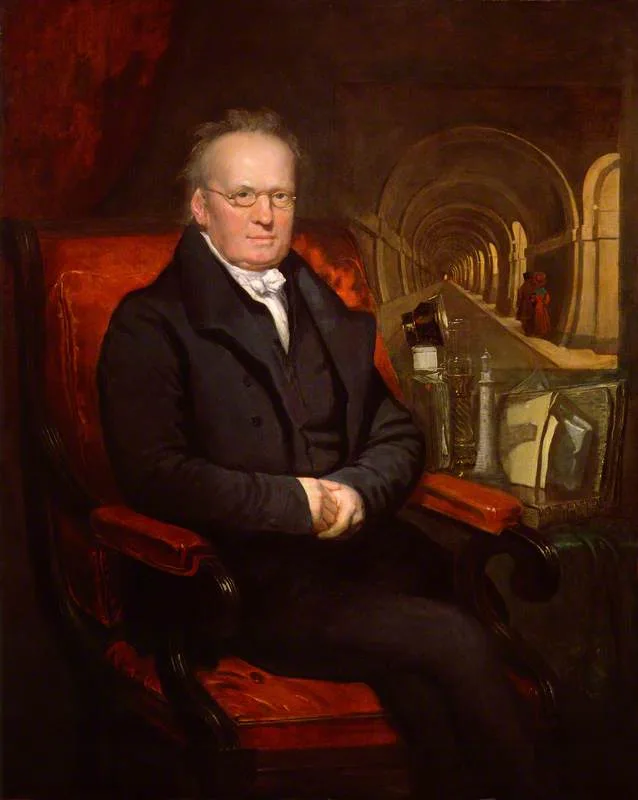
- Portrait of Sir Marc Isambard Brunel, National Portrait Gallery (Public domain, Samuel Drummond) - Wikimedia Commons file page
- Thames Tunnel construction, 1830 (Public domain, Unknown author) - Wikimedia Commons file page
- Portrait of Isambard Kingdom Brunel, National Railway Museum (Public domain, John Callcott Horsley) - Wikimedia Commons file page


Verified Archival Sources & Bibliography
Every claim in this account has been fact-checked against primary archives and scholarly repositories:
- UCLA Department of Epidemiology Historical Archive — The Thames Tunnel (1825–1871) (primary)
- LIFE Archive — London’s Oldest Underwater Tunnel (reference)
- Brunel 200 Historical Archive — Marc and Isambard Brunel’s Thames Tunnel (reference)
- The New York Times — Tunnel Drilling: From Brunel’s Shield to Modern Compression Chambers (news)
- BBC News — The Thames Tunnel Fancy Fairs and Victorian Opening (news)
- The Guardian — Inside the Brunel Thames Tunnel Grand Entrance Hall (news)
- The Independent — The Great Bore in Its Time, a Forgotten Gem in Ours (news)
- The Brunel Museum Rotherhithe — Official Historical Site Archive (reference)
Historical Connection Graph
A River Smelled So Bad That Parliament Nearly Fled. So They Rebuilt London.
AJ. "Six Men Died Building This Tunnel Under the River Thames." Echoes of History Uncut. Last modified October 17, 2026. https://echoesofhistoryuncut.com/articles/thames-tunnel/.

An independent digital history publication and documentary studio reconstructing historical turning points through primary archives, official inquiries, and scholarly citations. Every factual claim in this dossier is cross-referenced to the numbered bibliography above.