
The Day a 42-MPH Wind Twisted the Tacoma Narrows Bridge Apart
The original Tacoma Narrows Bridge in Puget Sound, Washington State, collapsed on November 7, 1940. On that day, a stiff gale set upon the area, which enhanced the rolling movement of the span. The main span gave way, sending a car belonging to Coatsworth and his daughter's dog plummeting into the Narrows, where the water was reported to be over 100 feet deep.
In this dossier (8 chapters) ▾
- 01 The Gale Over Puget Sound
- 02 Tubby the Cocker Spaniel and the Last Man on the Span
- 03 Insurance Fraud and the Battle Over the Design
- 04 Solid Plate Girders, Aeroelastic Flutter, and the North Cable Band
- 05 Why It Matters
- 06 What the Record Shows
- 07 Archival Evidence & Picture Credits
- 08 Verified Archival Sources & Bibliography
Historical Dossier: The Collapse of the Original Tacoma Narrows Bridge Location: Puget Sound, Tacoma, Washington State | Year: 7 November 1940 | Key Figures: Professor F. B. Farquharson, Leon Moisseiff, Clark Eldridge, Leonard Coatsworth
The Gale Over Puget Sound
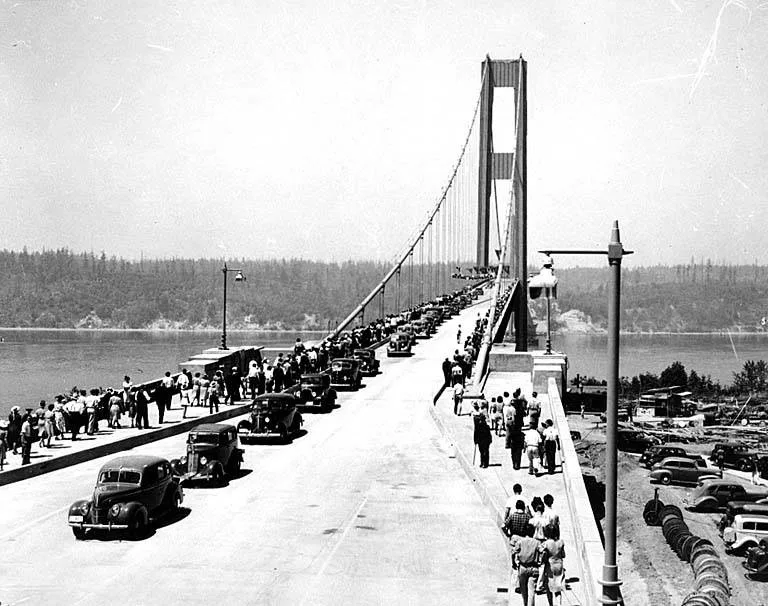
On the morning of November 7, 1940, a stiff 42-mile-per-hour gale swept northward through Puget Sound in Washington State, striking the slender, 2,800-foot main suspension span of the original Tacoma Narrows Bridge. Opened to traffic just four months earlier on July 1, 1940, to connect Tacoma with the Kitsap Peninsula and the Puget Sound Navy Yard at Bremerton, the third-longest suspension bridge in the world had already earned the nickname “Galloping Gertie” from ironworkers and motorists because its remarkably narrow two-lane roadway undulatingly rose and fell several feet even in light breezes.
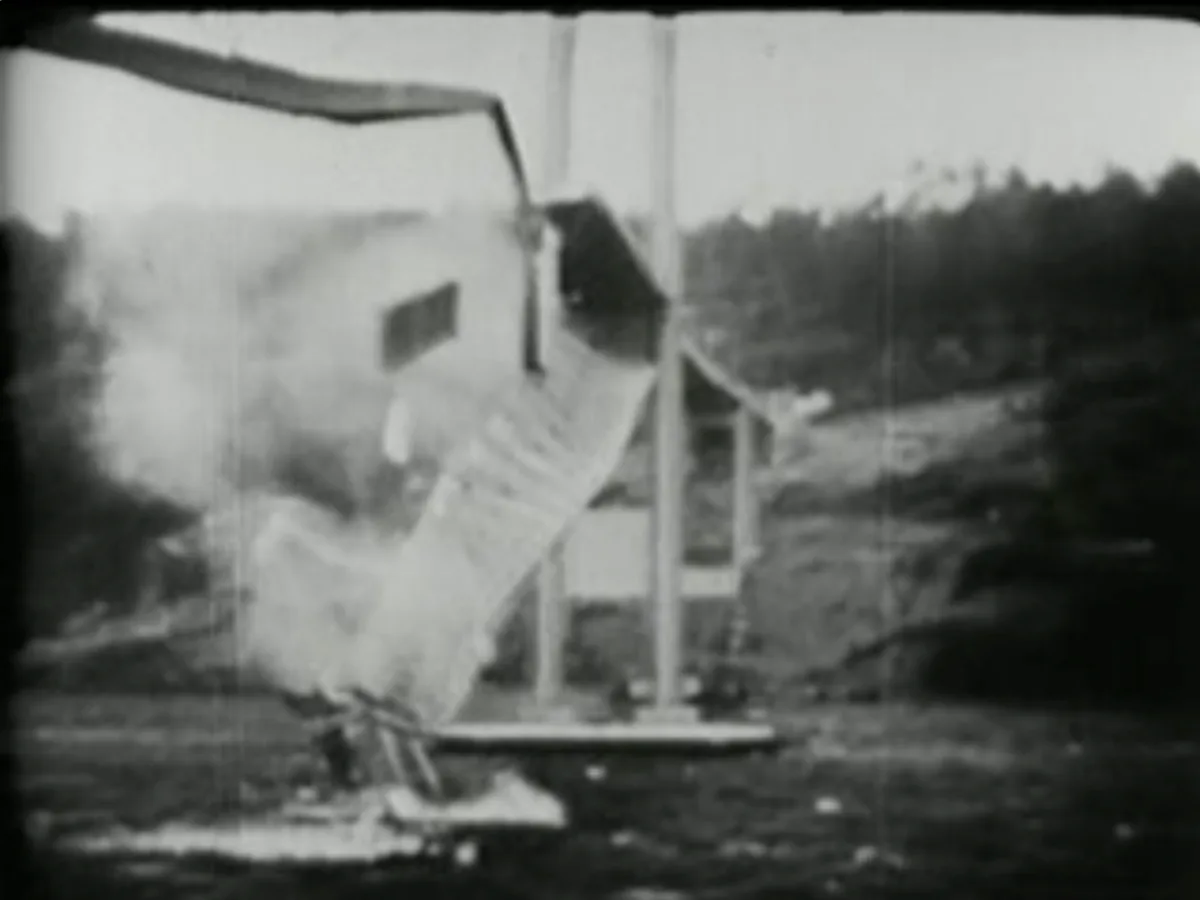
Throughout the early morning hours of November 7, the bridge vibrated in its familiar vertical wave motion, with nodes rising and falling along the length of the deck. Then, just after 10:00 a.m., the character of the oscillation changed abruptly and catastrophically. Instead of heaving purely up and down, the roadway entered a violent torsional mode, twisting up to 45 degrees in each direction around its centerline so that one curb plunged twenty-eight feet below the opposite sidewalk before whipping upward seconds later. Before noon, at approximately 11:02 a.m., the main center span tore apart in massive sections of structural steel and reinforced concrete while the unloaded side approaches sagged thirty feet toward the shore. Plunging with the falling roadway into the cold tidal waters of the Narrows—reported to be over 100 feet deep—was a stranded black 1938 Studebaker coupe belonging to Tacoma News Tribune copy editor Leonard Coatsworth, still carrying his daughter’s pet dog trapped inside.
Tubby the Cocker Spaniel and the Last Man on the Span
Coatsworth had driven onto the bridge just before toll collectors closed the gates, bound for his family cabin on the Kitsap Peninsula with Tubby—a three-legged, partially paralyzed black cocker spaniel belonging to his fourteen-year-old daughter. Halfway across the center span, the violent twisting pitched the Studebaker against the curb. Coatsworth tried to coax the terrified dog out of the car, but Tubby panicked in the bucking cabin and retreated into the back seat. Forced to abandon the vehicle, Coatsworth crawled on his hands and knees over nearly five hundred yards of heaving concrete, scraping his hands and knees raw until he reached the eastern toll plaza.
The last human being on the disintegrating bridge was Professor F. B. “Bert” Farquharson, a civil engineering professor at the University of Washington who had spent months testing a 1:200 scale model of the bridge in Seattle and was out on the span with Tacoma camera-shop owner Barney Elliot filming its oscillations on 16mm Kodachrome color motion-picture film. Learning that a dog was still trapped inside the stranded car, Farquharson crept out along the twisting roadway and reached into the Studebaker to pull Tubby free, only for the terrified spaniel to bite his knuckle to the bone. As concrete slabs began cracking and steel suspender cables snapped like rifle shots into the sky, Farquharson scrambled back toward the tower just moments before the 600-foot center section dropped into Puget Sound. Tubby perished when the car plummeted into the Narrows, becoming the disaster’s sole fatality; neither the vehicle nor the dog’s remains were ever recovered from the swift tidal channel.
Insurance Fraud and the Battle Over the Design
The morning after the collapse, newspapers across the United States carried front-page wire photographs and eyewitness accounts of the ruined suspension bridge. Washington State filed claims declaring the structure a total loss; insurance policies covered 80 percent—or $5,200,000—of the bridge’s valuation, and after litigation the recovered funds were set aside to finance a replacement crossing.
Yet the financial aftermath immediately exposed a brazen white-collar crime. When state officials notified the twenty-two insurers underwriting the bridge, the Merchants Fire Assurance Company stunned Olympia by reporting that it had no record of an $800,000 policy on the bridge. Investigators discovered that Hallett R. French, the Seattle general agent for Merchants Fire Assurance, had personally pocketed the hefty insurance premiums—gambling that an enormous steel suspension bridge would never actually fall down. Arrested and charged with grand larceny, French had to watch from prison as his secret embezzlement was unmasked by a 42-mph wind. Meanwhile, Washington State highway bridge engineer Clark Eldridge pointed blame squarely at the federal Public Works Administration (PWA) and Reconstruction Finance Corporation, whose insistence that an eastern consulting firm redesign his original truss plan for lower cost had cut the budget from $11 million to $6.4 million and produced an unsound, dangerously narrow structure.
Solid Plate Girders, Aeroelastic Flutter, and the North Cable Band
That eastern consultant was Leon Moisseiff, the celebrated New York suspension-bridge designer who had served as consulting engineer on the Golden Gate Bridge and whose mathematical “deflection theory” allowed bridges to be built ever lighter and narrower by relying on the weight of the main cables to absorb wind loads. At Tacoma Narrows, Moisseiff replaced Eldridge’s proposed 25-foot-deep open stiffening trusses with sleek, solid eight-foot-deep carbon-steel plate girders, while narrowing the roadway to just 39 feet between cables—an unprecedented width-to-length ratio of 1:72.
Following the disaster, Moisseiff acknowledged that the collapse occurred because bridge engineers did not yet understand suspension-bridge aerodynamics, while project engineers emphasized that the failure stemmed from improper aerodynamic shape rather than defective steel or workmanship. In March 1941, a federal investigative board headed by Othmar Ammann and aerodynamicist Theodore von Kármán reported that while full structural conclusions required dismantling the wreckage, the bridge’s extreme slenderness, shallow floor, and solid plate girders were the root causes of failure. Rather than allowing Puget Sound winds to pass freely through an open web truss, the solid eight-foot girders acted like an airplane wing stalled in a crosswind, shedding alternating vortices and feeding self-excited aeroelastic torsional flutter that pumped more wind energy into every twist of the deck. The specific mechanical trigger that converted vertical waves into fatal twisting at 10:00 a.m. was the slippage of the center diagonal cable band on the north main suspension cable under shear forces it was never built to resist. Once both federal and state boards concluded that the twisted towers and cables could not be repaired, plans to dismantle the remaining superstructure were briefly halted in December 1941 after Pearl Harbor, before the salvaged steel was melted down for the Second World War effort.
Why It Matters
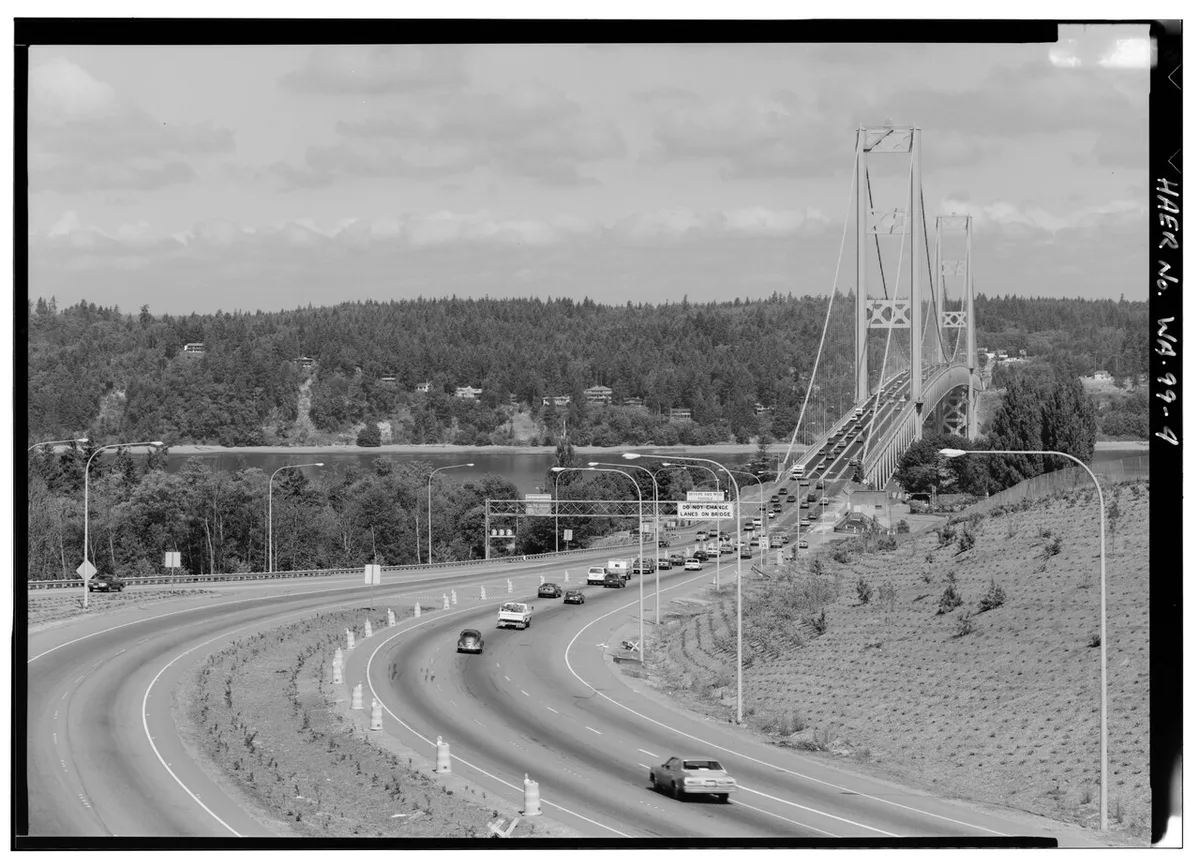
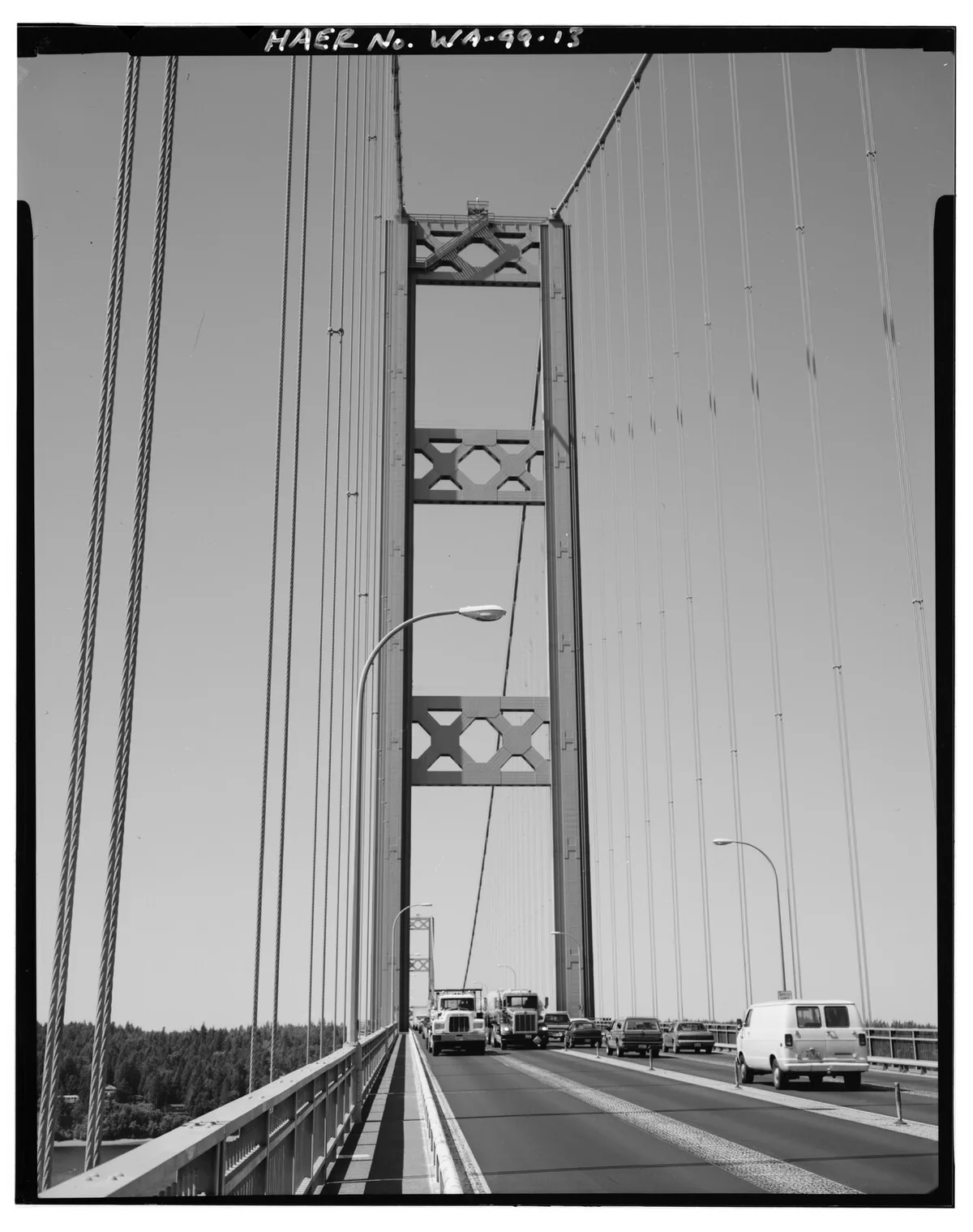
The destruction of the 1940 Tacoma Narrows Bridge ended an era in which suspension bridges were designed solely for static dead weight and static horizontal wind pressure. When the replacement bridge opened in October 1950, it featured 33-foot-deep open stiffening trusses, a 60-foot-wide four-lane deck with open steel grating slots to vent wind pressure, and hydraulic damping buffers—setting the modern standard in which wind-tunnel testing and aeroelastic stability govern every long-span bridge on Earth.
What the Record Shows
27 sourced claims in this story, resting on 2 sources. Numbers link to the bibliography below.
- The original Tacoma Narrows Bridge collapsed on November 7, 1940. - source: 1
- The bridge was located in Puget Sound, Washington State. - source: 1
- On November 7, a stiff gale set upon Puget Sound, enhancing the span’s rolling movement. - source: 1
- The main span gave way, sending Coatsworth’s car and his daughter’s dog plummeting into the Narrows. - source: 1
- The water was reported to be over 100 feet deep at that location. - source: 1
- The dog perished when the car it was trapped in plummeted into the Narrows. - source: 1
- Tubby was missing a leg and was partially paralyzed. - source: 1
- Farquharson was the last person on the bridge. - source: 1
- Farquharson was a civil engineering professor at the University of Washington. - source: 1
- The bridge was claimed as a total loss. - source: 2
- 80% or $5,200,000 of the structure’s valuation was covered by the insurance policies. - source: 2
- The funds from the insurance claims were put aside to help build the new bridge. - source: 2
- Tubby’s remains were never found. - source: 1
- Newspapers were full of accounts of the bridge collapse the day after it happened. - source: 2
- Hallett R. French, an agent for the Merchants Fire Assurance Company, was charged with grand larceny for withholding premiums on $800,000 worth of insurance. - source: 2
- Clark Eldridge, chief engineer for the bridge, felt that the federal money-lending agencies’ ‘insistence’ that the bridge be designed by an eastern firm led directly to the bridge’s unsound design. - source: 2
- The consulting designer, Leon Moisseiff, felt the fall occurred because engineers did not know enough about aerodynamics. - source: 2
- Engineers on the project maintained that the bridge’s collapse was due to improper shape and not improper strength. - source: 2
- An investigative board reported in March 1941 that the cause of the collapse could not be identified until the wreckage had been torn down and studied. - source: 2
- The board concluded that the primary reasons for failure were the general proportions of the bridge and the type of girders and floor. - source: 2
- The solid girders made the bridge sensitive to wind forces that had been previously considered unimportant. - source: 2
- The specific cause of the bridge’s fall was the slippage of the center cable band on the north cable due to forces it wasn’t strong enough to resist. - source: 2
- The center span of the bridge fell. - source: 2
- The approaches of the bridge sagged. - source: 2
- Both boards felt that repair of the bridge was not possible. - source: 2
- Discussions of the methods to be used in deconstructing the bridge were halted in December 1941. - source: 2
- Steel supplies were redirected towards the war effort. - source: 2
Archival Evidence & Picture Credits
Every image on this page was checked against its Wikimedia Commons file page.
- Opening day of the Tacoma Narrows Bridge, 1940 (Public domain, University of Washington Libraries Digital Collections) - Wikimedia Commons file page
- Remains of the 1940 Tacoma Narrows Bridge (CC BY 3.0, Timbabcock) - Wikimedia Commons file page
- Archival film frame of the Tacoma Narrows Bridge collapse (Public Domain, Barney Elliot) - Wikimedia Commons file page
- Original unreplaced approach from the first Tacoma Narrows suspension bridge (Public domain, Jet Lowe, HAER) - Wikimedia Commons file page
- General view of eastern approach and roadway at Tacoma Narrows (Public domain, Jet Lowe, HAER) - Wikimedia Commons file page
- Eastern tower in elevation at Tacoma Narrows (Public domain, Jet Lowe, HAER) - Wikimedia Commons file page


Verified Archival Sources & Bibliography
Every claim in this account has been fact-checked against primary archives and scholarly repositories:
- American Society of Civil Engineers (ASCE) — Professor Farquharson’s Dog and the November 7, 1940 Collapse (primary)
- University of Washington Libraries Special Collections — Tacoma Narrows Bridge Collapse & Engineering Board Investigation (primary)
Historical Connection Graph
Trapped on the Ocean Floor in 240 Feet of Water
AJ. "The Day a 42-MPH Wind Twisted the Tacoma Narrows Bridge Apart." Echoes of History Uncut. Last modified October 16, 2026. https://echoesofhistoryuncut.com/articles/tacoma-narrows-bridge-1940/.

An independent digital history publication and documentary studio reconstructing historical turning points through primary archives, official inquiries, and scholarly citations. Every factual claim in this dossier is cross-referenced to the numbered bibliography above.