
The Hasanlu Lovers: The 2,800-Year-Old Kiss That Fooled History
In 1972, archaeologists at Teppe Hasanlu discovered two 2,800-year-old skeletons locked in what appeared to be an eternal embrace under collapsed burning ruins. For decades romanticized as star-crossed lovers, forensic analysis revealed the harrowing reality of their final moments.
In this dossier (6 chapters) ▾
Historical Dossier & Archival Audit: The Hasanlu Lovers (SK 335 & SK 336) Site: Teppe Hasanlu, Solduz Valley, West Azerbaijan, Iran | Estimated Date: ~800 BCE (Iron Age II) | Excavation Date: 1972 | Lead Archaeologist: Robert H. Dyson Jr. (Penn Museum) | Current Repository: National Museum of Iran, Tehran
Frozen in the Rubble of a Sacked Citadel
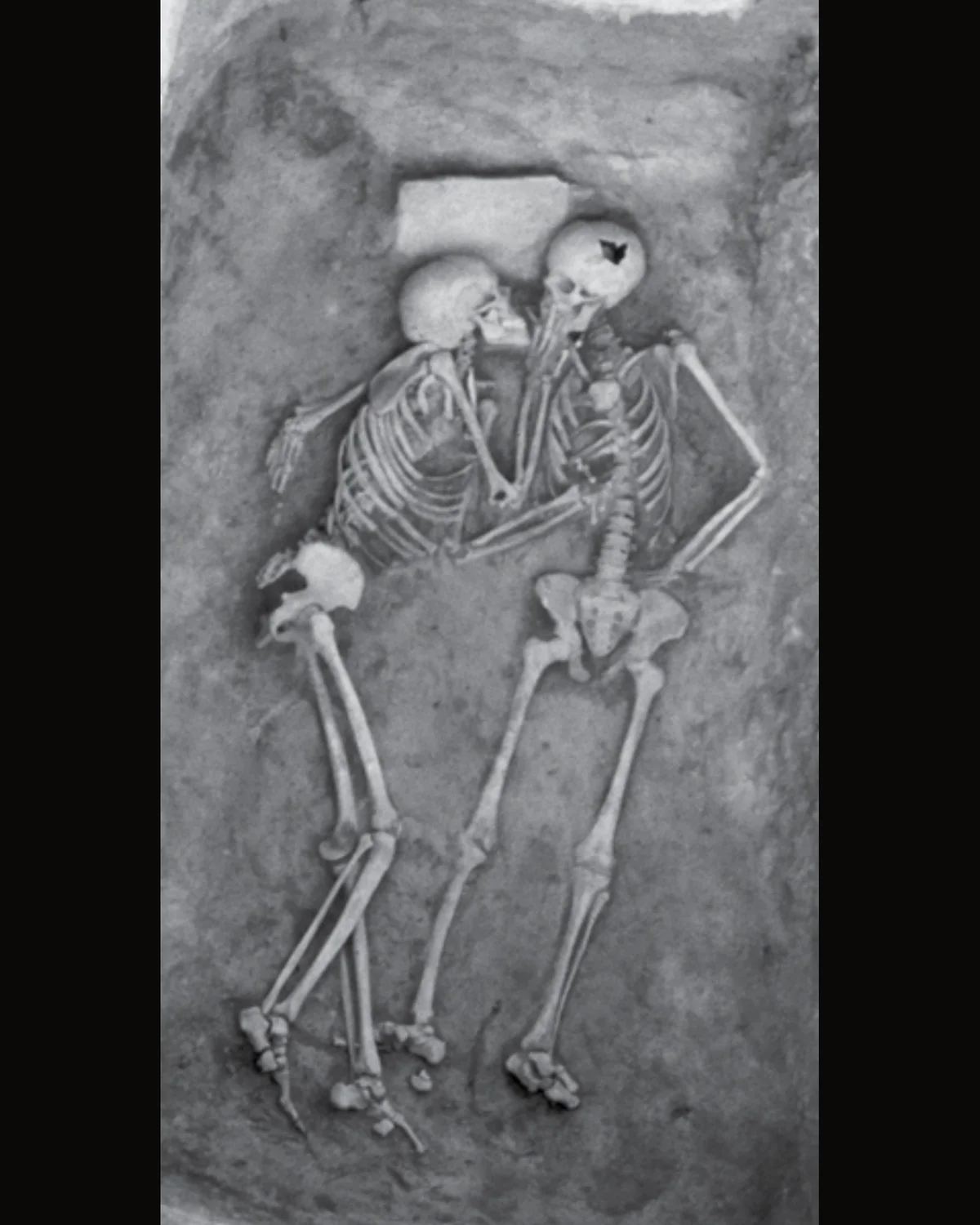
In the summer of 1972, an archaeological team from the University of Pennsylvania Museum of Archaeology and Anthropology and the Metropolitan Museum of Art was conducting excavations at Teppe Hasanlu in northwestern Iran. Led by American archaeologist Robert H. Dyson Jr., the team was investigating the fortified Iron Age settlement that had met a catastrophic, fire-fueled end nearly three millennia earlier. While clearing a plaster-lined storage trench or mudbrick grain bin, excavators uncovered an extraordinary sight: two human skeletons lying together in an intimate posture that appeared to capture their final seconds of life.
The skeleton on the left lay on its back, while the skeleton on the right lay on its left side, facing the first individual with an outstretched right arm cupping the other’s cheek or chin. To the excavation team and the global public, the pose was unmistakable: the two appeared to be sharing an eternal kiss, holding each other in the darkness as their citadel collapsed in smoke and flame. The discovery quickly captured international attention and became universally known as the “Hasanlu Lovers.”
The Catastrophe of 800 BCE
To understand how the two individuals came to rest in this position, physical anthropologists and historians had to reconstruct the final hours of the city. Around 800 BCE, Teppe Hasanlu was a thriving, fortified center of the Solduz Valley, featuring monumental multi-story buildings, columnar halls, and extensive storerooms filled with bronze, gold, and ivory artifacts.
Without warning, an overwhelming attacking force—historians frequently attribute the assault to the expanding kingdom of Urartu, though neighboring Assyrian and regional rivals remain plausible—breached the citadel’s defenses. The invaders set the complex ablaze, burning the heavy timber beams supporting the upper floors.
The fire spread with ferocious speed. As walls of mudbrick and flaming ceilings crashed downward, dozens of inhabitants and defenders were trapped inside the complex. Excavations throughout Hasanlu have documented bodies crushed beneath collapsed masonry in hallways and stairwells, alongside bronze helmets and scattered weapons.
For the two individuals dubbed the “Lovers,” survival was impossible. Cut off from exits, they sought refuge inside an empty, plaster-lined storage bin set into the floor. The absence of grave goods, jewelry, or formal burial positioning confirms that they were not buried as part of a funerary ritual; rather, they scrambled into the trench as a desperate shelter from the raging fire above. They perished from rapid asphyxiation and the weight of the burning debris that sealed them beneath thick layers of charred timber and ash for 2,800 years.
The Forensic Science: Challenging the Legend
For nearly four decades after the 1972 excavation, popular literature, museum exhibitions, and media articles portrayed the skeletons as a romantic young couple: a heroic man holding his dying female partner. However, modern bioarchaeological and osteological assessments began systematically dismantling this romanticized assumption.
Physical anthropologists examining the pelvic morphology and cranial features of both skeletons made a startling revelation:
- The Left Individual (SK 335): Bioarchaeological analysis of pelvic and cranial markers identified this skeleton as a young biological male, aged approximately 19 to 22 years old at the time of death. His skeleton showed no evidence of healed chronic illnesses or weapon trauma.
- The Right Individual (SK 336): While early popular accounts described this individual as female, extensive osteological, dental, and mandibular analyses by modern researchers established that this individual was also biologically male, aged approximately 30 to 35 years old.
- Trauma Analysis: The older individual (SK 336) exhibited a severe, unhealed cranial fracture to the left side of his skull—a blunt-force injury likely inflicted by an attacker’s mace or collapsing masonry moments before entering the bin.
Subsequent paleogenomic and ancient DNA studies across Iron Age Near Eastern populations have reinforced that both individuals were biological males. As bioarchaeologists at the Penn Museum highlighted in their landmark investigation “Lovers, Friends, or Strangers?”, the moniker “lovers” is an interpretation of their physical pose, not an established biological or historical fact. They could have been comrades-in-arms defending the citadel, father and son, brothers, romantic partners, or strangers desperately seeking comfort during the destruction of Hasanlu. What remains indisputable is their shared humanity: in the face of violent catastrophe, two people reached out to hold each other as their world collapsed into flame and ash.
What the Record Shows
- 1972 Discovery: Unearthed by the University of Pennsylvania Hasanlu Project led by Dr. Robert H. Dyson Jr. in an Iron Age destruction layer.
- Dating: Stratigraphically sealed around 800 BCE during the sudden sacking and burning of Teppe Hasanlu.
- Shelter Context: Found in a plaster-lined storage bin with zero grave goods, proving they died trapped during the citadel’s destruction rather than through deliberate burial.
- Forensic Demographics: Both individuals are biologically male—one aged approximately 19–22 years, the other aged 30–35 with significant perimortem cranial trauma.
- Current Preservation: The skeletal assemblage is permanently curated in the National Museum of Iran in Tehran.
Archival Evidence & Picture Credits
- Figure 1: Hasanlu Lovers in situ excavation photograph (1972), courtesy of the Hasanlu Project, Penn Museum / Metropolitan Museum of Art Joint Expedition. Public domain and Wikimedia Commons archival licensing.
Verified Archival Sources & Bibliography
- Selinsky, Page. “Lovers, Friends, or Strangers?” Expedition Magazine, Penn Museum, Vol. 59, No. 2, 2017. Penn Museum Article / Illustrated PDF.
- Dyson, Robert H., Jr. “The Hasanlu Project, 1968–1972.” Expedition Magazine, Penn Museum, Vol. 14, No. 4, 1972.
- Muscarella, Oscar White. The Bronze and Iron Age Objects from Hasanlu, Iran. Metropolitan Museum of Art, 1988.
- Penn Museum Archival Collections. Hasanlu Excavation Records: Skeletal Catalog SK 335 & SK 336. Philadelphia, PA.
- Wikipedia: Hasanlu Lovers.
- National Museum of Iran. Permanent Exhibition of the Iron Age: The Hasanlu Embrace. Tehran, Islamic Republic of Iran.
Historical Connection Graph
A King Built a Giant Warship. It Sank in 20 Minutes
AJ. "The Hasanlu Lovers: The 2,800-Year-Old Kiss That Fooled History." Echoes of History Uncut. Last modified November 17, 2026. https://echoesofhistoryuncut.com/articles/the-hasanlu-lovers/.

An independent digital history publication and documentary studio reconstructing historical turning points through primary archives, official inquiries, and scholarly citations. Every factual claim in this dossier is cross-referenced to the numbered bibliography above.