
The Denny's Dynasty: How Jensen Huang Built Nvidia, Bet the Farm, and Lost the Throne
Before commanding a $3 trillion computing empire, Jensen Huang washed dishes and cleaned restrooms at Denny's. In 1993, he co-founded Nvidia in a roadside diner booth. In November 2026, an explosive corporate inquiry into export controls, family nepotism, and undisclosed ties brought an abrupt end to Silicon Valley's longest-running CEO reign.
In this dossier (11 chapters) ▾
- 01 The November 2026 Reckoning
- 02 Act I: The Dishwasher’s Education (1963–1992)
- 03 Act II: The Berryessa Road Diner Booth (1993)
- 04 Act III: Thirty Days from Insolvency & The RIVA 128 (1995–1997)
- 05 Act IV: Inventing the GPU & The $500M CUDA Gamble (1999–2012)
- 06 Act V: The Sovereign AI Monopoly & The Family Dynasty (2016–2026)
- 07 Act VI: The Export Control Crosshairs & The Resignation (2025–2026)
- 08 Epilogue: Full Circle from the Diner Booth
- 09 What the Record Shows
- 10 Archival Evidence & Picture Credits
- 11 Verified Archival Sources & Bibliography
Historical Dossier & Archival Audit: Jensen Huang & The Rise of Nvidia Founding Location: Denny’s, 2484 Berryessa Road, San Jose, California | Incorporation Date: April 1993 | Founders: Jen-Hsun “Jensen” Huang, Chris Malachowsky, Curtis Priem | Milestone Breakthroughs: RIVA 128 (1997), GeForce 256 (1999), CUDA (2006) | Tenure: 1993–2026 (33 Years)
The November 2026 Reckoning
In November 2026, Silicon Valley witnessed the conclusion of the longest and most consequential chief executive tenure in modern computing history. After thirty-three continuous years at the helm of Nvidia, Jen-Hsun “Jensen” Huang stepped down as chief executive officer [1].
To the broader world, Huang was the leather-jacketed visionary who had guided a fledgling three-person startup from a noisy highway diner booth into a three-trillion-dollar colossus standing at the undisputed center of global artificial intelligence. Every major frontier AI laboratory on Earth—from OpenAI and Google DeepMind to Microsoft, Meta, and Anthropic—relied on clusters of tens of thousands of Nvidia GPUs to train and infer their largest neural models [2, 6].
Yet beneath the triumphal public keynotes and stratospheric market valuations, Huang’s departure was precipitated by an unprecedented internal and external crisis. An aggressive board-level inquiry, combined with mounting federal scrutiny from the United States Department of Commerce and intelligence agencies, laid bare an insular corporate governance structure that operated less like an audited public blue-chip corporation and more like a tight-knit family dynasty [1].
The story of Nvidia is not merely a tale of technological prophecy and relentless commercial execution; it is the saga of a high-wire thirty-three-year gamble that began over bottomless cups of diner coffee, twice survived near-instant annihilation, and ultimately collided with the brutal realities of geopolitical power and corporate control.
Act I: The Dishwasher’s Education (1963–1992)
Before Jensen Huang commanded global supply chains spanning Taiwan Semiconductor Manufacturing Company (TSMC) to hyperscale American data centers, his world was defined by the industrial hum of restaurant kitchens and the smell of grease traps [2].
Born in Tainan, Taiwan, in 1963, Huang spent parts of his childhood in Thailand before his parents sent him and his brother to live with an uncle in the United States. His early American schooling was rugged; assigned by mistake to the Oneida Baptist Institute in rural Kentucky—a reform academy rather than a prep boarding school—Huang was tasked with cleaning the dormitory toilets daily while navigating a rough, alien environment [2].
When the family reunited and settled outside Portland, Oregon, the teenage Huang sought employment at a local Denny’s restaurant in Aloha, Oregon. He began at the lowest rung of the culinary hierarchy: scrubbing dishes, scraping burned hash browns from cast-iron griddles, and cleaning restrooms [2, 3]. He eventually earned a promotion to busboy and later to table server.
Huang has repeatedly cited that grueling restaurant work as the most formative leadership academy of his life. In multiple addresses, including his archival 2024 Stanford Graduate School of Business interview, Huang reflected on the lessons of the kitchen:
“I was probably Denny’s best dishwasher. I was so organized, so fast. I never left dishes dirty, and I left no work on the table. You learn that no task is beneath you. In business, if you don’t do the unglamorous groundwork with absolute precision, everything above it collapses” [3].
After graduating with an electrical engineering degree from Oregon State University in 1984 and earning a master’s degree from Stanford University in 1992, Huang entered the fast-moving Silicon Valley microprocessor sector, taking engineering roles at AMD and LSI Logic [4]. But his ambition reached beyond improving existing CPU architectures.
Act II: The Berryessa Road Diner Booth (1993)
In late 1992, Huang reconnected with two gifted microchip architects: Chris Malachowsky and Curtis Priem, both senior engineers at Sun Microsystems who were growing frustrated with corporate bureaucracy [4].
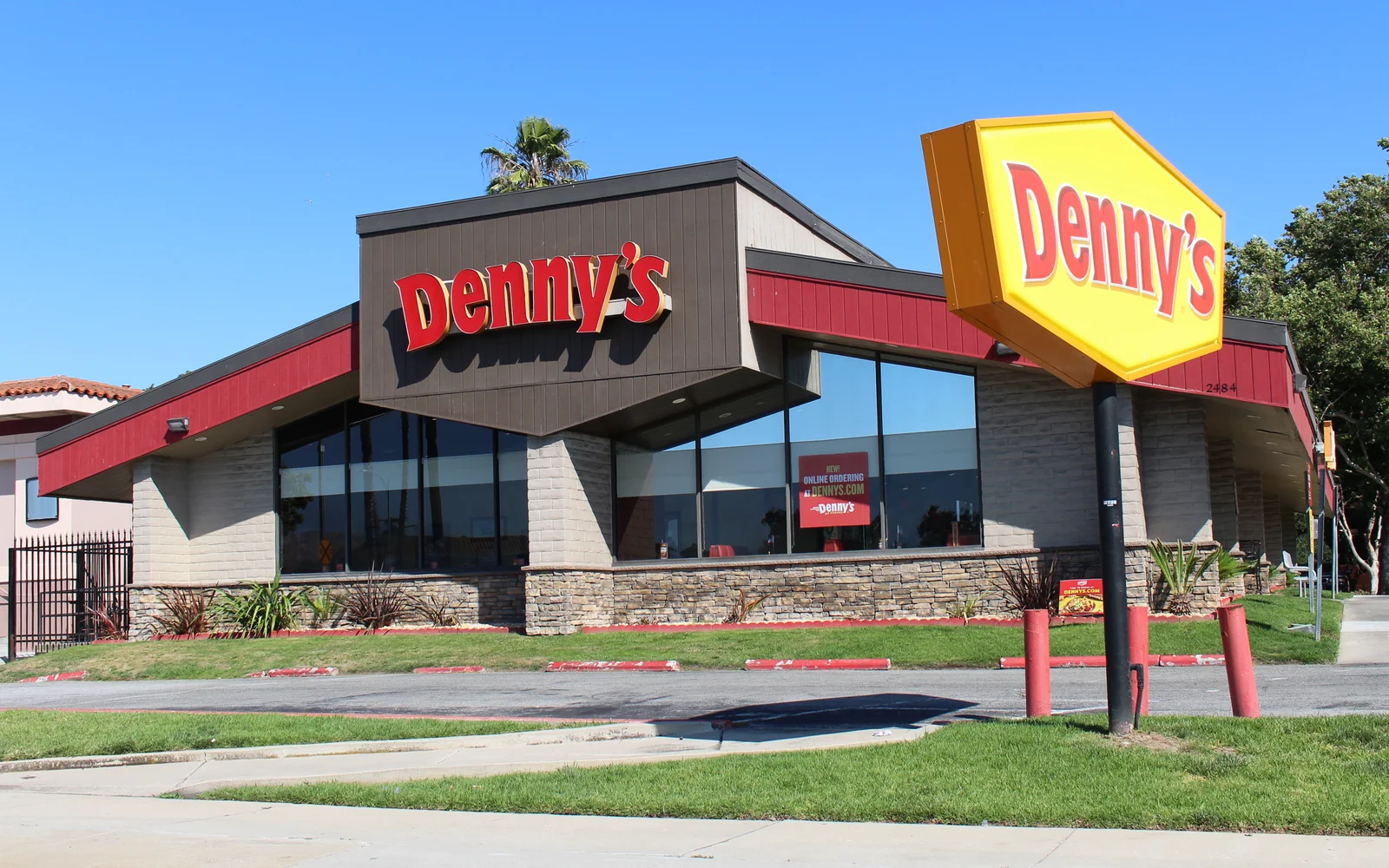
Seeking a neutral, informal meeting space where they could converse for hours without being evicted by management, the trio chose a roadside Denny’s diner located at 2484 Berryessa Road in northeastern San Jose [3, 4]. Sitting in a vinyl-upholstered corner booth, surviving on bottomless coffee refills and plates of scrambled eggs, they spent evenings debating the next frontier of personal computing.
Their conclusion was radical for 1993. Most computer scientists viewed personal computers primarily as business calculation tools—machines destined for spreadsheets, databases, and word processing. Huang, Malachowsky, and Priem argued the opposite: personal computers were destined to become consumer entertainment appliances. The single most computationally brutal challenge facing computers was rendering real-time three-dimensional imagery for video games [4, 5].
If they could construct a specialized chip dedicated exclusively to 3D geometric calculations, they could relieve the central processing unit (CPU) of an overwhelming mathematical burden. In April 1993, with $40,000 in pooled personal savings, Nvidia was formally incorporated [4]. The name drew inspiration from “invidia,” the Latin root for envy.
Act III: Thirty Days from Insolvency & The RIVA 128 (1995–1997)
The infant company nearly ceased to exist almost immediately. In 1995, Nvidia unveiled its debut product, the NV1 multimedia card [4, 5]. It was an unmitigated commercial and technical disaster.
Rather than adopting the standard polygon-mesh mathematical approach—where 3D virtual worlds are assembled from thousands of flat triangular facets—Nvidia engineers gambled their architecture on curved quadratic surfaces [4, 5]. When Microsoft released its foundational Direct3D API in 1996, it standardized universally on triangular polygons. Overnight, the NV1 became technologically incompatible with the entire nascent PC gaming industry.
The financial fallout was catastrophic. Hardware manufacturers canceled orders, revenue evaporated, and Nvidia burned through its venture capital reserves. Huang was forced to cut more than half the company’s workforce, downsizing headcounts from over a hundred employees to roughly forty core engineers [3, 4].
By autumn 1996, the company’s treasury was virtually depleted. Internal accounting revealed that Nvidia had approximately thirty days of payroll cash remaining before mandatory liquidation [3].
Faced with imminent bankruptcy, Huang refused to surrender to incremental compromises. He gathered the remaining engineers and staked every last dollar of the company’s surviving capital on a do-or-die architecture: the RIVA 128 (Real-time Interactive Visual Architecture) [5].
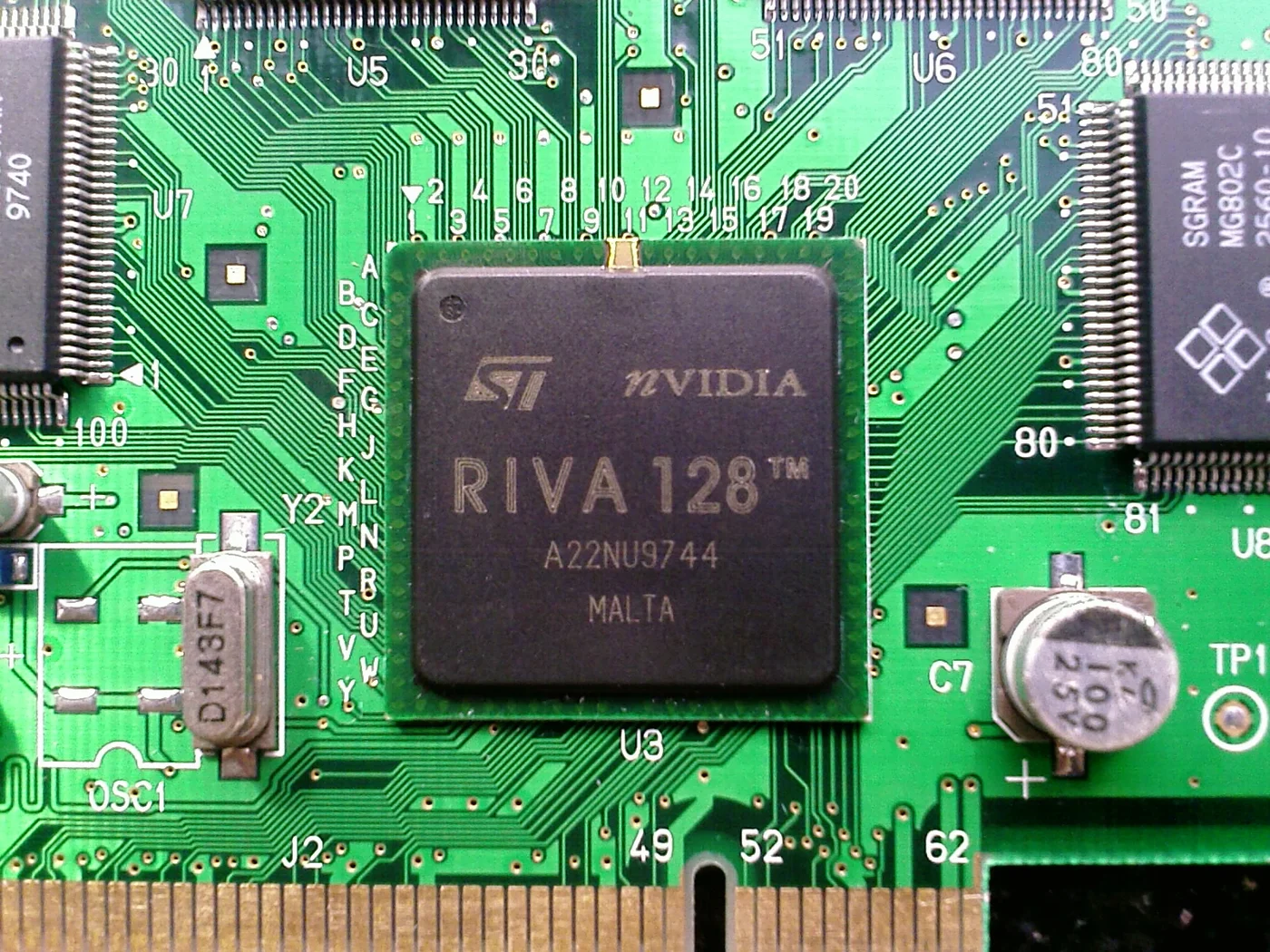
Designed strictly around 128-bit hardware acceleration for Direct3D triangular polygons, the RIVA 128 delivered staggering performance, running games at four times the speed of competing accelerators while integrating 2D GUI acceleration and video playback onto a single die [5].
When the chip shipped in late 1997, it became an instant phenomenon. Nvidia sold more than one million units in under four months, secured an indispensable licensing deal with Sega, and completely refilled its depleted corporate coffers [4, 5]. The startup had pulled off one of the sharpest turnaround resurrections in Silicon Valley history.
Act IV: Inventing the GPU & The $500M CUDA Gamble (1999–2012)
Having achieved liquidity, Nvidia executed an initial public offering on the Nasdaq in January 1999 [4]. Nine months later, in October 1999, the company launched the product that permanently defined its industry identity: the GeForce 256 [7].
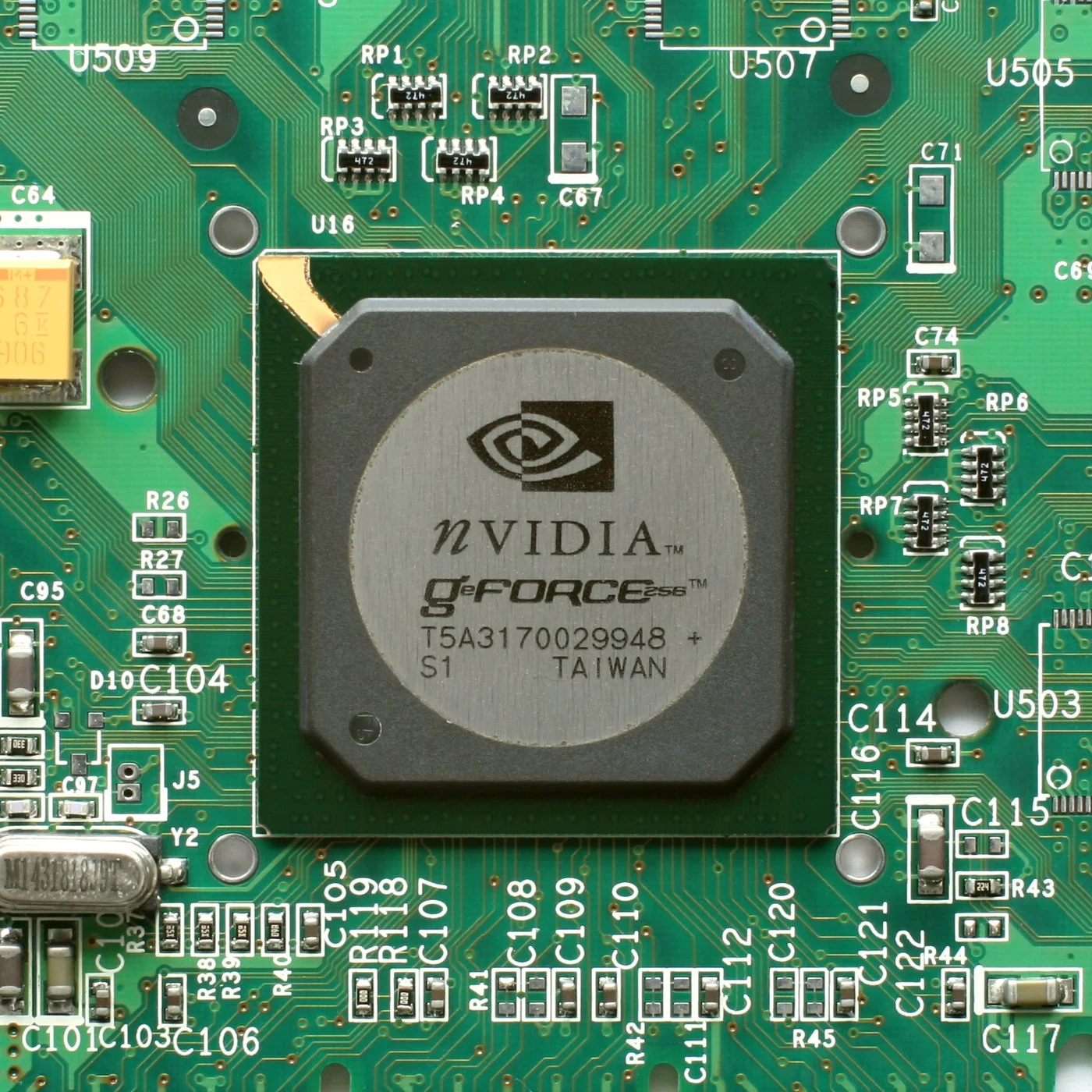
Nvidia coined the term “GPU” (Graphics Processing Unit), defining it as a single-chip processor integrating transform, dynamic lighting, triangle clipping, and rasterization engines capable of processing at least ten million polygons per second [7]. By offloading complex floating-point vector geometry from the host CPU to dedicated silicon, the GeForce 256 created an entirely new hardware category.
Yet Huang’s greatest strategic masterpiece—and his most heavily penalized gamble—commenced in 2006 with the introduction of CUDA (Compute Unified Device Architecture) [8].
CUDA was designed to transform Nvidia’s graphics chips from single-purpose gaming accelerators into programmable general-purpose supercomputers [8]. Instead of requiring computer scientists to translate mathematical problems into complex 3D shader coordinates, CUDA allowed programmers to write native C and C++ code directly executed across thousands of parallel GPU processing cores [8].
The commercial cost of CUDA was staggering. Embedding general-purpose compute hardware into every consumer graphics chip increased silicon surface area, raised manufacturing costs, and depressed gross profit margins [3, 8]. For nearly a decade, Nvidia spent approximately $500 million annually developing CUDA software and developer compilers without generating substantial offsetting enterprise revenue [3]. Wall Street analysts repeatedly urged Huang to abandon the initiative and return focus to high-margin consumer gaming.
Huang stood firm, weathering a punishing decline in company share price. His thesis was unyielding: sequential computing on CPUs was approaching fundamental thermodynamic limits (Dennard scaling), and the future of computation belonged irrevocably to massively parallel vector architectures [3, 8].
His vindication arrived in 2012. At the University of Toronto, doctoral researchers Alex Krizhevsky and Ilya Sutskever, working under computer science pioneer Geoffrey Hinton, trained a deep convolutional neural network named “AlexNet” [9]. Using two consumer-grade Nvidia GeForce GTX 580 graphics cards programmed via CUDA, AlexNet pulverized every classical computer vision benchmark at the ImageNet competition [9].
Virtually overnight, the artificial intelligence research community realized that GPUs were the missing physical substrate required to breathe life into decades of dormant neural network mathematics [6, 9].
Act V: The Sovereign AI Monopoly & The Family Dynasty (2016–2026)
From 2016 onward, Nvidia transitioned from a gaming component manufacturer into the world’s most critical sovereign infrastructure provider [2, 6].
In 2016, Huang personally delivered the first DGX-1 supercomputing cluster to an obscure non-profit startup called OpenAI [2]. When OpenAI launched ChatGPT in late 2022, triggered by clusters of thousands of Nvidia A100 and H100 processors, the world entered a hyper-capitalized AI arms race [2, 6]. Tech giants—Microsoft, Meta, Amazon, and Alphabet—allocated hundreds of billions in capital expenditures competing for Nvidia’s chip allocations. By mid-2024, Nvidia briefly surpassed Microsoft and Apple to become the most valuable publicly traded enterprise on Earth, commanding a market capitalization exceeding $3.3 trillion [2].
Yet inside Nvidia’s Santa Clara headquarters, the internal governance structure remained strikingly insular [1]. A detailed November 2026 journalistic investigation by CNN business and artificial intelligence correspondent Hadas Gold revealed that, despite managing a multitrillion-dollar publicly held firm, Huang operated the enterprise with the centralized control of a private family business [1].
Key executive and managerial nodes across Nvidia’s organizational hierarchy were occupied by members of Huang’s immediate family:
- Lori Huang (Spouse of 40+ Years): Oversaw the multibillion-dollar Huang Family Foundation, which exercised significant stewardship and voting influence over personal and family equity holdings [1].
- Madison Huang (Daughter): Held the position of Senior Director of Product & Technical Marketing for Physical AI and the Omniverse platform, commanding an annual compensation package exceeding $1.2 million [1].
- Spencer Huang (Son): Served as Director of Product Management for robotics and autonomous machines, overseeing crucial edge-computing roadmaps with a compensation package exceeding $1.3 million [1].
- Nico Capress (Son-in-Law): Married to Madison Huang, Capress ascended to Vice President of Global AI Infrastructure Growth, directing critical data-center sales pipelines and hyperscaler allocation priorities [1].
While family involvement in founder-led startups is commonplace during early incubation stages, maintaining close familial control over key product roadmaps and infrastructure allocation at a three-trillion-dollar public company drew growing discomfort from corporate governance watchdogs and institutional asset managers [1].
Act VI: The Export Control Crosshairs & The Resignation (2025–2026)
The insular governance model might have persisted unchallenged had it not collided directly with international geopolitics [1].
Beginning in late 2022 and accelerating through 2025, the United States Department of Commerce imposed increasingly draconian export controls designed to deny advanced AI acceleration hardware—specifically Nvidia’s high-bandwidth Hopper and Blackwell architectures—to Chinese entities and military research facilities [1, 2].
For Nvidia, which historically generated more than 20% of its corporate revenue from mainland China, the sanctions threatened tens of billions in annual cash flow [1]. While Nvidia developed modified, lower-bandwidth variants (such as the A800, H800, and H20) to maintain compliance, illicit gray-market distribution networks rapidly proliferated across Southeast Asia and the Middle East to smuggle uncapped hardware into sanctioned markets [1].
Federal investigators and intelligence agencies began examining intermediary distribution firms handling Nvidia silicon shipments [1]. Among the companies scrutinized was Megaspeed, a specialized international hardware customer and distribution partner [1].
Internal whistleblower alerts reached the Nvidia board of directors alleging severe export compliance circumvention and, crucially, undisclosed conflicts of interest [1]. The board’s audit committee initiated an independent inquiry, uncovering personal relationships connecting senior leadership to external executives—including undisclosed ties involving Alice Huang, an executive associated with Megaspeed, alongside an undisclosed relationship with an internal subordinate [1].
The convergence of federal regulatory scrutiny, whistleblowers, and governance lapses created an unsustainable crisis [1]. Faced with a formal board inquiry and potential regulatory enforcement actions, Jensen Huang reached an agreement with the board in November 2026 to relinquish the chief executive role after thirty-three uninterrupted years [1].
While retaining a ceremonial board and advisory capacity, the executive helm passed to non-family leadership, formally ending an era that had redefined global computing [1].
Epilogue: Full Circle from the Diner Booth
History rarely offers neat, unblemished endings.
Jensen Huang’s thirty-three-year tenure represents one of the most astonishing arcs in the history of human industry. He took an idea sketched on paper napkins in a highway diner booth and transformed it into the computational architecture of human thought. His refusal to surrender during the 1996 thirty-day insolvency crisis, coupled with his decadelong defense of the CUDA architecture against the skepticism of Wall Street, demonstrated a rare operational audacity and technological prescience [2, 3, 8].
Yet the very traits that enabled Nvidia’s ascent—uncompromising personal control, fierce insularity, and an unwillingness to delegate authority—ultimately sowed the seeds of his executive downfall [1]. In building a digital empire, Huang constructed a corporate fortress that operated by the personal loyalties of a family dynasty, even as its silicon became the most contested geopolitical asset on the planet [1].
Decades after scrubbing grease from plates at Denny’s, Jensen Huang departed at the absolute pinnacle of technological influence—leaving behind a three-trillion-dollar empire, an altered planet, and an enduring monument to the power of pure, unadulterated engineering willpower.
What the Record Shows
- The Diner Dishwasher Origin: Jensen Huang worked as a dishwasher and busboy at Denny’s during his youth in Oregon, an experience he consistently credited with instilling extreme operational rigor and humility [2, 3].
- The 1993 Incorporation: Huang, Chris Malachowsky, and Curtis Priem planned the company at a Denny’s booth at 2484 Berryessa Road in San Jose, incorporating Nvidia in April 1993 with $40,000 [3, 4].
- The 30-Day Bankruptcy Brink: The failure of the NV1 chip in 1995 forced layoffs of over 60% of staff, leaving Nvidia with thirty days of operating cash in late 1996 before the RIVA 128 saved the firm [3, 5].
- The Invention of the GPU: Nvidia launched the GeForce 256 in October 1999, officially defining the Graphics Processing Unit and shifting geometric floating-point math to dedicated silicon [7].
- The CUDA Platform Gamble: In 2006, Nvidia introduced CUDA, spending ~$500 million annually for years to establish universal parallel computing despite fierce Wall Street opposition [3, 8].
- The AlexNet Catalyst: In 2012, AlexNet won ImageNet using two consumer Nvidia GPUs running CUDA, sparking the modern deep learning revolution [9].
- The Family Dynasty Governance: A CNN investigation by Hadas Gold in November 2026 highlighted that multiple key executive roles were held by immediate family members, including daughter Madison Huang, son Spencer Huang, and son-in-law Nico Capress [1].
- The November 2026 Resignation: Amid Commerce Department export scrutiny, distribution channel probes involving Megaspeed, and an internal board investigation into undisclosed relationships, Huang stepped down as CEO after 33 years [1].
Archival Evidence & Picture Credits
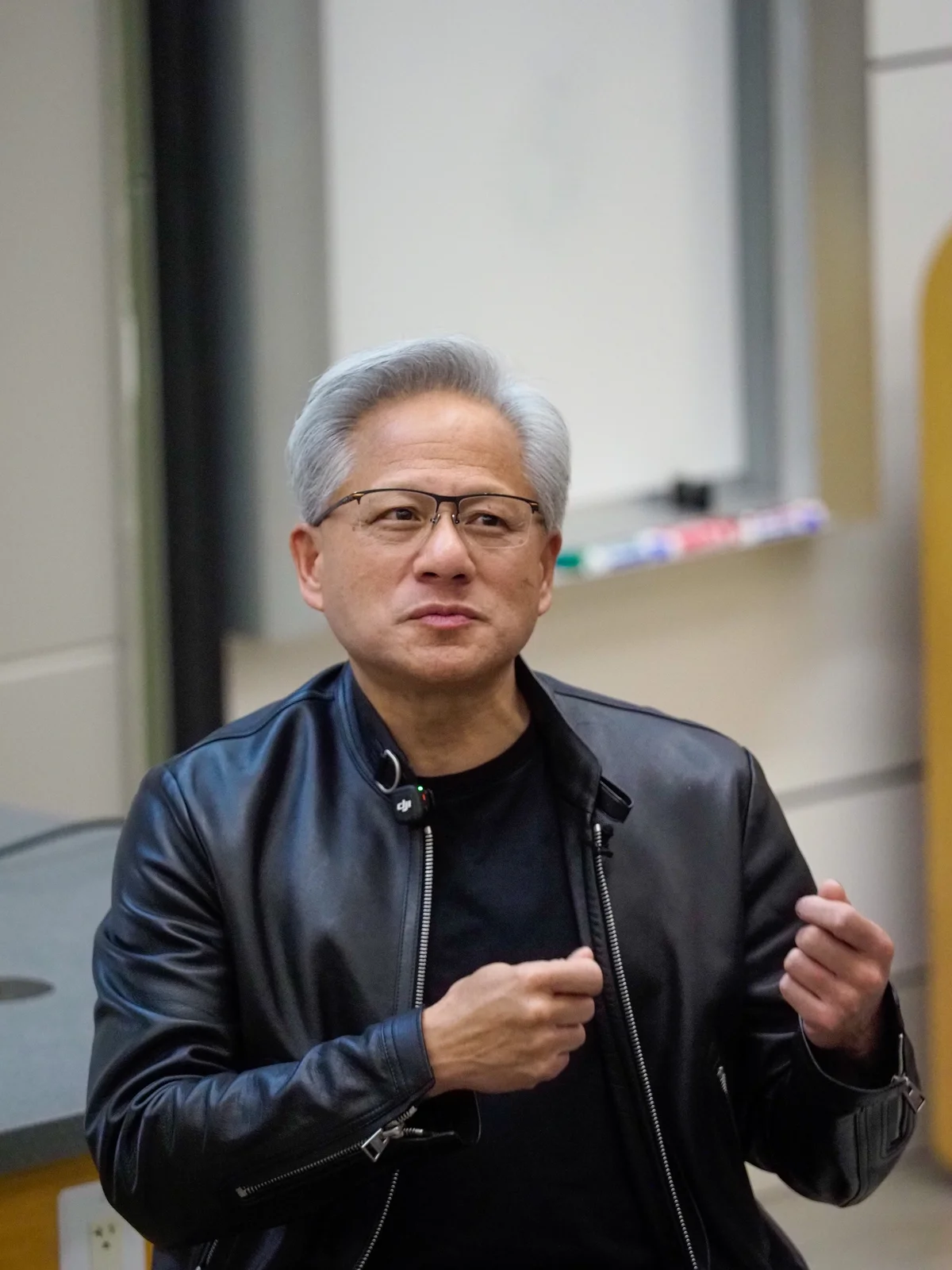
- Jensen Huang Keynote Address (2026): Photographed by Anders Eidesvik on April 30, 2026, at Stanford University. Archival portrait in signature leather jacket. Licensed under CC BY 4.0 via Wikimedia Commons.
- Denny’s Restaurant at 2484 Berryessa Road (San Jose, CA): Photographed by Coolcaesar on July 2, 2023. Capturing the roadside diner where Nvidia was conceived in 1992–1993. Licensed under CC BY-SA 4.0 via Wikimedia Commons.
- Nvidia RIVA 128 Graphics Processor (1997): Photographed by Appaloosa. Macro detail of the breakthrough 128-bit chip that saved Nvidia from corporate liquidation. Licensed under CC BY-SA 3.0 via Wikimedia Commons.
- Nvidia GeForce 256 Processor (1999): Photographed by Konstantin Lanzet. Macro detail of the world’s first designated GPU. Licensed under CC BY-SA 3.0 via Wikimedia Commons.
Verified Archival Sources & Bibliography
- CNN Business & Artificial Intelligence Investigation (Hadas Gold, November 2026). “Inside Nvidia’s Family Dynasty: Whistleblowers, Export Controls, and the Resignation of Jensen Huang.” Investigative report detailing the board inquiry, Megaspeed scrutiny, familial executive appointments, and Huang’s departure.
- The New Yorker (Stephen Witt, December 2023). “How Jensen Huang’s Nvidia Grew from a Denny’s Booth to Power the AI Revolution.” Biographical profile exploring Huang’s childhood, early employment at Denny’s, and the founding narrative.
- Stanford Graduate School of Business (March 2024). “View From The Top: Jensen Huang, Co-Founder and CEO of NVIDIA.” Official Stanford GSB archival interview recounting the 30-day runway crisis, early layoffs, and the decadelong CUDA capital expenditures.
- Computer History Museum (Oral History Collection, 2018). “Oral History of Chris Malachowsky and Curtis Priem.” Reference CHM Lot X8484.2018. Archival transcripts detailing the founding of Nvidia in 1993, the NV1 quadratic curve crisis, and early venture backing.
- IEEE Micro (Vol. 18, Issue 4, July/August 1998). “RIVA 128: A Highly Integrated 128-Bit 3D and Multimedia Accelerator.” Technical specification and architectural overview of the processor that salvaged Nvidia’s business model.
- The Economist (March 2024). “The AI Hardware Hegemony: How Nvidia Built an Unassailable Moat.” Economic analysis of CUDA software switching costs and hyperscaler GPU demand.
- Nvidia Corporation Press Archives (August 31, 1999). “NVIDIA Introduces the World’s First GPU: GeForce 256.” Archival corporate press release formally defining the Graphics Processing Unit.
- Communications of the ACM (Vol. 51, No. 10, October 2008). “CUDA: Scalable Parallel Programming for High-Performance Computing on GPUs.” Landmark architectural analysis on the transition from specialized 3D acceleration to general-purpose scientific computing.
- Advances in Neural Information Processing Systems (NeurIPS 2012) (Alex Krizhevsky, Ilya Sutskever, Geoffrey E. Hinton). “ImageNet Classification with Deep Convolutional Neural Networks.” The seminal benchmark paper demonstrating GPU-accelerated deep neural network training.
Explore more verified historical dossiers on The Hasanlu Lovers and browse our full investigative catalog in the Archival Timeline and Historical Dossiers Archive.
Historical Connection Graph
The War of the Currents: Edison, Westinghouse and Tesla's Motor
AJ. "The Denny's Dynasty: How Jensen Huang Built Nvidia, Bet the Farm, and Lost the Throne." Echoes of History Uncut. Last modified November 18, 2026. https://echoesofhistoryuncut.com/articles/jensen-huang-and-the-rise-of-nvidia/.

An independent digital history publication and documentary studio reconstructing historical turning points through primary archives, official inquiries, and scholarly citations. Every factual claim in this dossier is cross-referenced to the numbered bibliography above.