
1,134 Passengers. One Fog Bank. About 50 Died.
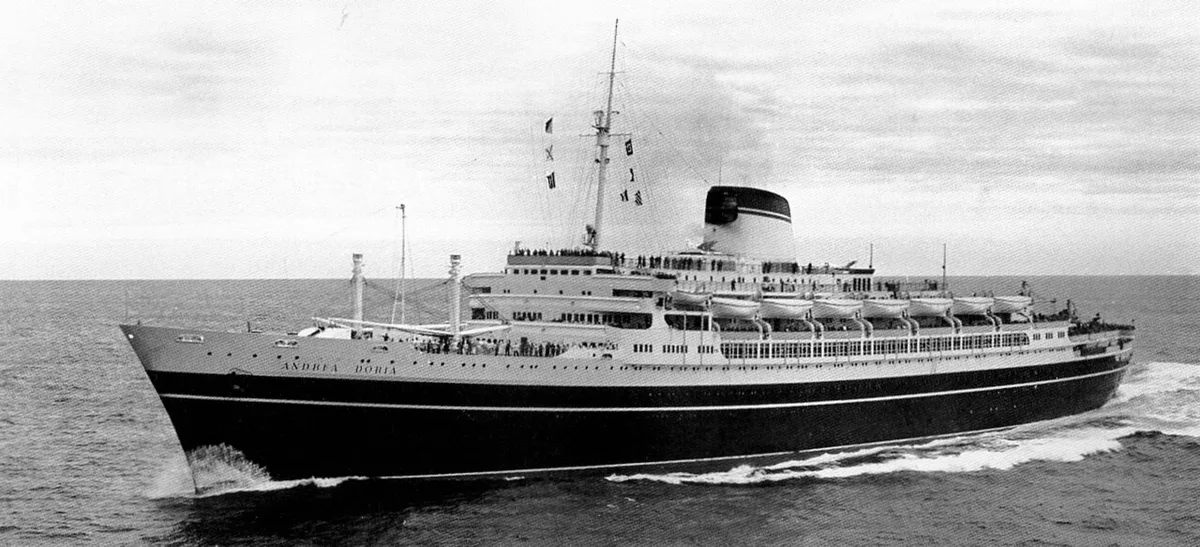
At 11:00 p.m. in the dense Nantucket fog bank known to mariners as Times Square, the Swedish liner MS Stockholm tore open the side of the Italian flagship SS Andrea Doria. Carrying 1,134 passengers and listing at a 45-degree angle with flooded generators, the stricken ocean liner stayed afloat for eleven hours while the Île de France and nearby vessels rescued 1,663 survivors.
In this dossier (9 chapters) ▾
Historical Dossier: The Collision and Sinking of SS Andrea Doria Location: Off Nantucket, North Atlantic (“Times Square”) | Year: July 1956 | Key Figures: Captain Piero Calamai, Third Officer Johan-Ernst Carstens-Johannsen, Crew of the Île de France
Collision in the Nantucket Fog
At 11:10 p.m. on the fog-shrouded night of July 25, 1956, the 12,165-ton Swedish American Line passenger-cargo vessel MS Stockholm drove its ice-reinforced steel bow nearly thirty feet into the starboard side of the 29,100-ton Italian Line luxury flagship SS Andrea Doria. Westbound from Genoa to New York on the final night of a nine-day transatlantic crossing, the Andrea Doria—celebrated across Europe as a floating museum of postwar Italian art and industrial design—had 1,134 passengers and 572 crew members on board, many of whom had already packed their luggage in anticipation of docking at Pier 84 on the Hudson River the next morning.
The stretch of the North Atlantic roughly forty-five miles south of Nantucket Island where the two ships converged was known to transatlantic mariners as “Times Square” because of the relentless volume of eastbound and westbound shipping lanes crossing through the corridor near the Nantucket Lightship. Because warm Gulf Stream currents collided directly with frigid Labrador waters over the Nantucket Shoals, the sea lane was notoriously blanketed in dense, pea-soup summer fog.
Radar Misreading on the Bridge
On the bridge of the westbound Andrea Doria, fifty-eight-year-old Captain Piero Calamai had reduced speed only slightly from 23 knots to 21.8 knots as his ship entered the heavy fog bank—a practice that, while violating the strict letter of international maritime rules requiring ships in reduced visibility to proceed at a speed allowing them to stop within half the distance of visibility, remained commonplace among competing transatlantic liners racing to maintain tight New York arrival schedules. Even with modern marine radar screens glowing on both bridges, neither watch realized how rapidly the two ships were closing almost head-on along reciprocal tracks.
Aboard the eastbound Stockholm, which had departed New York at 11:30 a.m. bound for Gothenburg under clear skies touching the edge of the fog bank, twenty-six-year-old Third Officer Johan-Ernst Carstens-Johannsen was conning the bridge alone. Spotting the Andrea Doria’s echo on his radar display about five minutes after an earlier plot, Carstens-Johannsen fatally misread the radar range-scale selector switch, believing his set was adjusted to the 15-mile scale when it was actually set to the 5-mile scale. As a result, Carstens-Johannsen thought the approaching Italian liner was 12 miles away when it was actually only 4 miles away. Worse still, without plotting a true course triangle, the Stockholm turned to starboard—as standard passing rules required in clear sight—at the exact moment Captain Calamai ordered a turn to port to give what he assumed was an overtaking or parallel vessel wider sea room. When the ships’ masthead lights finally broke through the wall of fog less than half a mile apart, the two liners had turned directly into each other’s path.
Listing 45 Degrees in the Dark
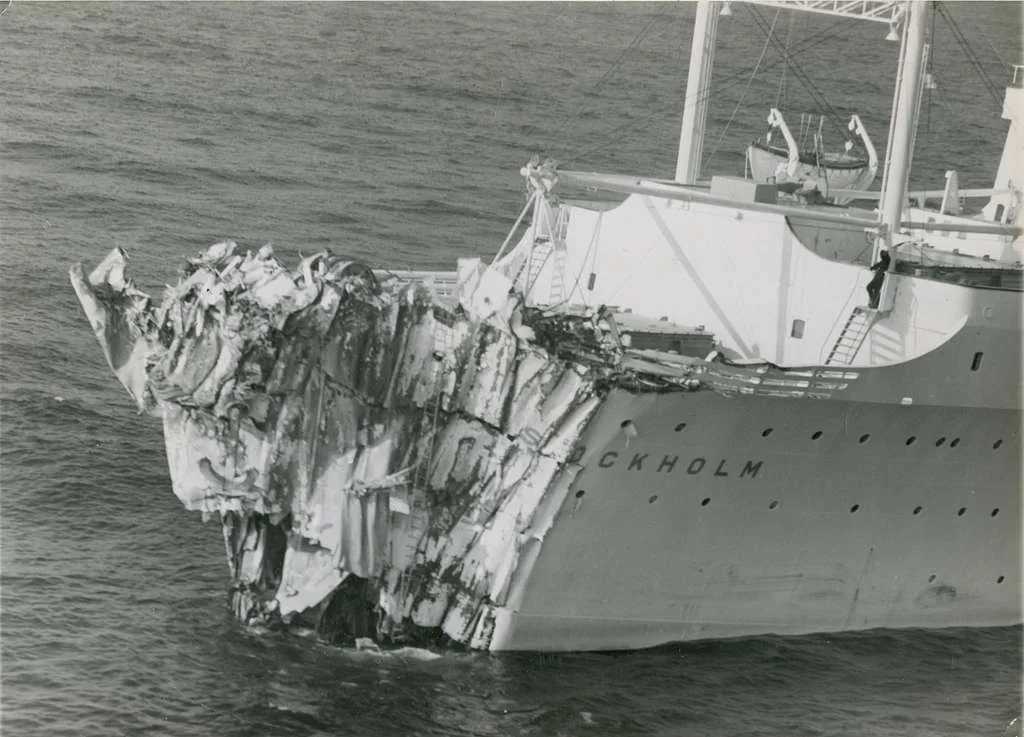
Built with a heavily reinforced icebreaker-style bow for Scandinavian winter waters, the Stockholm acted like a giant steel battering ram. It sliced thirty feet deep into the Andrea Doria’s starboard side just below the bridge, tearing open a gaping ragged gash from the Upper Deck all the way down to the double bottom. Forty-six passengers aboard the Andrea Doria and five crewmen in the crushed forward peak of the Stockholm were killed in the collision itself—while fourteen-year-old Linda Morgan, asleep in Cabin 52 on the Andrea Doria, was miraculously scooped intact onto the crumpled bow of the Stockholm as the ships wrenched apart.
Below the waterline, the Stockholm’s bow ruptured the Andrea Doria’s huge, empty starboard deep fuel tanks. Instead of being ballasted with seawater as fuel was burned during the crossing, those starboard tanks had been left dry to save the cost of pumping oily ballast water in New York. Hundreds of tons of Atlantic water immediately rushed into the starboard tanks while the portside tanks remained full of trapped air, pulling the 29,000-ton liner into an immediate 18-degree list that soon worsened toward 45 degrees as water spilled over the tops of watertight bulkheads. Because the ship heeled past the 15-degree operating limit of her lifeboat davits, all eight portside lifeboats hung hopelessly inboard over the canted deck, leaving only the eight starboard lifeboats—capable of holding fewer than half the people aboard—functional. As the list steepened, seawater flooded the auxiliary machinery compartment containing the main electric generators, short-circuiting the generators and switchboards and plunging the lower corridors into darkness.
The Île de France Turns Back
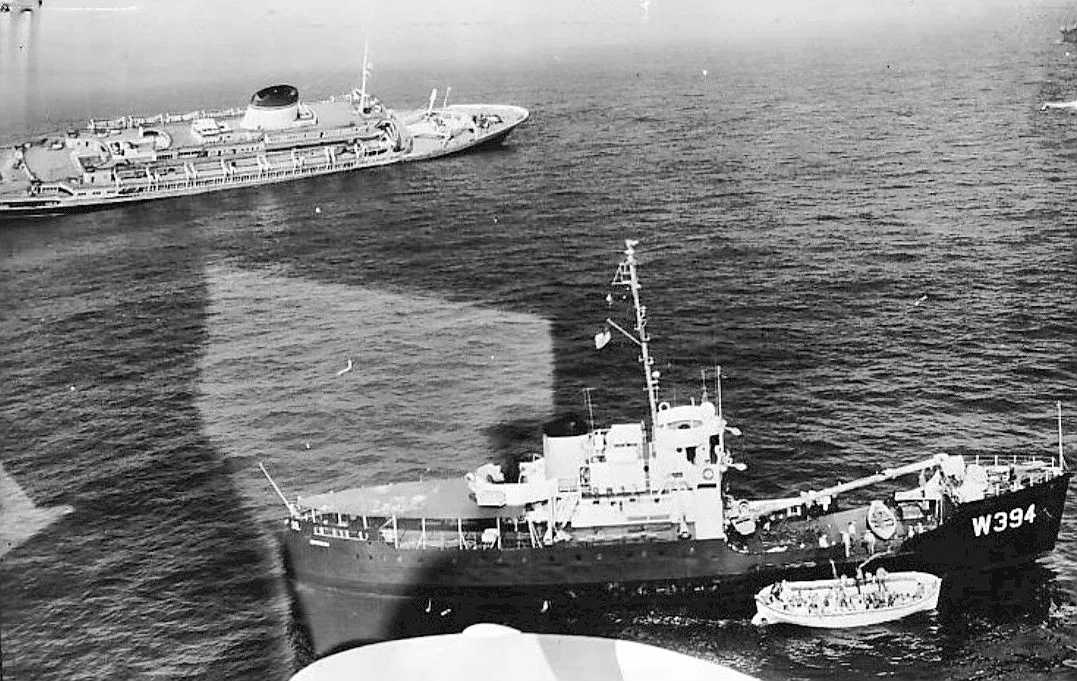
Urgent SOS calls flashed across the North Atlantic, bringing an international armada of merchant ships, U.S. Coast Guard cutters, Navy destroyers, and ocean liners racing toward the coordinates. The decisive turning point came forty-four miles to the east aboard the 44,356-ton French Line flagship SS Île de France. Although eastbound with a full passenger load, Captain Baron Raoul de Beaudean made the courageous decision to turn his giant liner around in the fog and steam at 22 knots back to the collision site.
When the Île de France glided out of the mist at 2:00 a.m. and switched on every deck light, floodlight, and illuminated funnel floodlamp, a roar of relief rose from the sloping decks of the Andrea Doria. Manoeuvring within four hundred yards of the listing wreck, the French liner launched ten lifeboats and shuttled back and forth through the night, taking on 753 survivors—the largest single share of the rescue. The damaged Stockholm herself took aboard 545 survivors, while the United Fruit freighter Cape Ann, the Navy transport USS Pvt. William H. Thomas, the destroyer escort USS Edward H. Allen, and the tidewater tanker Robert E. Hopkins (which picked up a single shipwrecked American sailor) rescued the remainder. By 6:00 a.m., every surviving passenger had been safely transferred across the water. On the steeply tilted bridge of the Andrea Doria, a heartbroken Captain Calamai initially refused to leave his dying ship, agreeing to step into a lifeboat only after his senior officers refused to leave without him and threatened to go down alongside him.
Eleven Hours to the Bottom
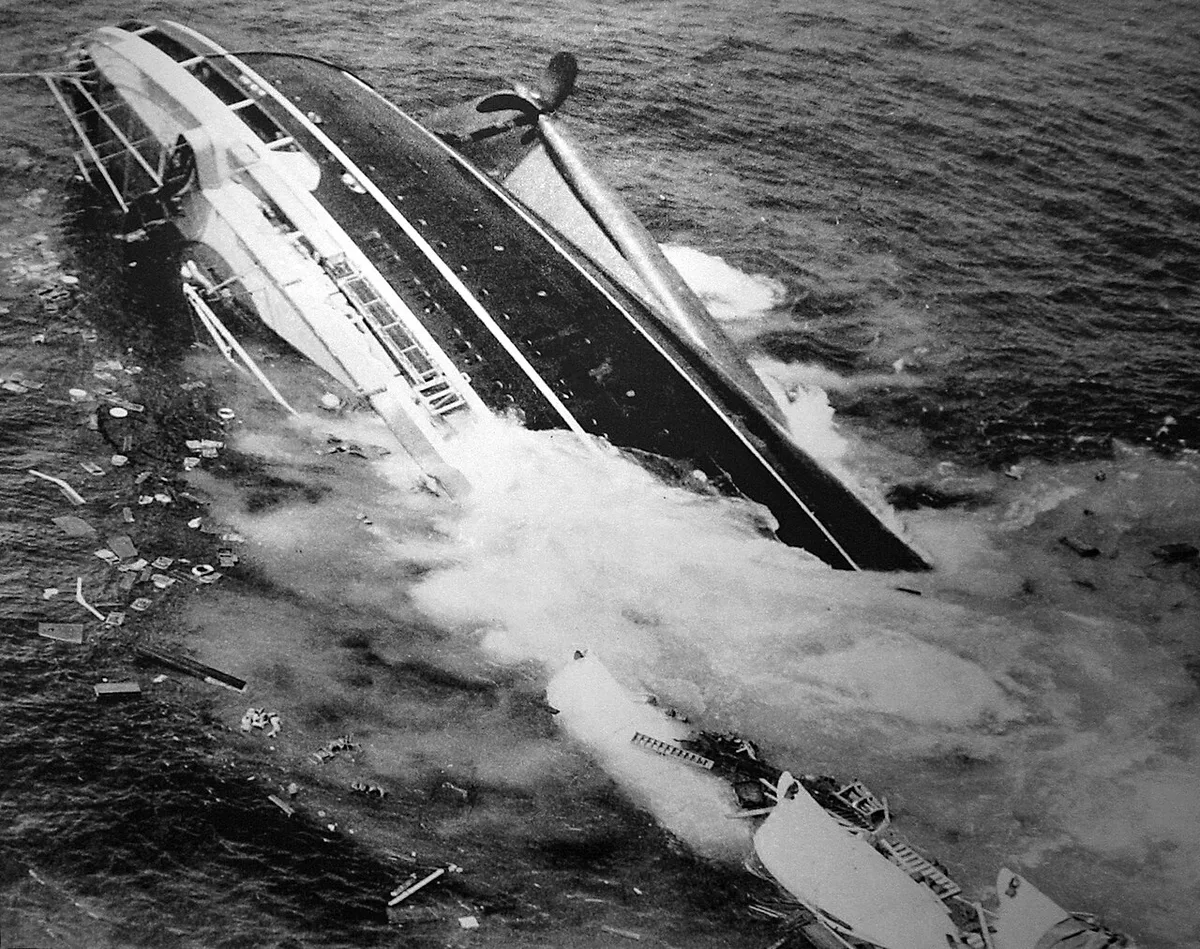
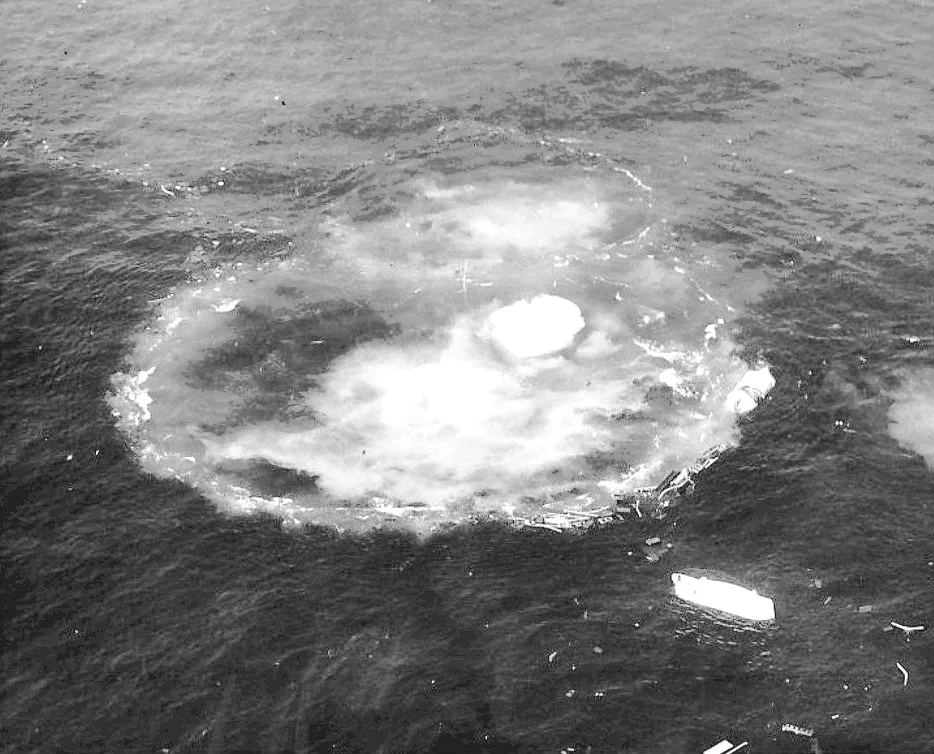
Crucially, despite the catastrophic gash in her side, the Andrea Doria stayed afloat for eleven hours after the collision. That eleven-hour reprieve—combined with rapid radio coordination and the seamanship of the Île de France and responding ships—enabled 1,663 passengers and crew to be saved in the greatest peacetime maritime rescue in history. At 10:09 a.m. on July 26, 1956, under bright morning sunlight as Boston Traveler photographer Harry A. Trask circled overhead in a small plane taking his Pulitzer Prize-winning photographs, the Andrea Doria rolled onto her starboard side, lifted her bronze propellers to the sky, and slipped beneath the waves to rest at a depth of 250 feet.
Why It Matters
More than half a century later, the 1956 sinking of the SS Andrea Doria remains of enduring interest to naval architects, maritime courts, and historians. As the most catastrophic and most recent collision in history between two transatlantic ocean liners, the disaster demonstrated that radar without systematic plotting could create “radar-assisted collisions.” The U.S. congressional investigation and subsequent 1960 SOLAS convention overhauled the International Regulations for Preventing Collisions at Sea—requiring mandatory radar observer training, strict separation of eastbound and westbound Nantucket shipping lanes, and improved cross-flooding stability rules for passenger hulls.
What the Record Shows
18 sourced claims in this story, resting on 5 sources. Numbers link to the bibliography below.
- The Stockholm struck the Doria at 11:00 p.m. - source: 1
- The Andrea Doria had 1,134 passengers on board. - source: 1
- The area off Nantucket known as Times Square was often foggy due to warm currents colliding with frigid waters. - source: 1
- Carstens-Johannsen saw the Doria on radar about five minutes later. - source: 1
- Carstens-Johannsen thought the Doria was 12 miles away when it was actually 4 miles away. - source: 1
- Captain Calamai of Andrea Doria was speeding in heavy fog. - source: 2
- The impact opened a gaping hole in the Doria’s side. - source: 1
- The ship was listing at a 45-degree angle and taking water by the minute. - source: 3
- Water flooded the compartment containing the main electric generators and short-circuited the generators and switchboards. - source: 3
- Île de France played the largest role in the rescue, taking on 753 survivors. - source: 2
- Survivors were transferred to various rescue ships by 6:00 a.m. - source: 1
- One American sailor was rescued by the tanker Robert E. Hopkins. - source: 2
- Captain Calamai initially refused to leave his ship but eventually agreed to step into a rescuing boat after being persuaded by his officers. - source: 4
- The Andrea Doria capsized eleven hours after the collision and was placed at a depth of 250 feet. - source: 4
- 1,663 passengers and crew were rescued from Andrea Doria. - source: 2
- About fifty people were killed in the collision. - source: 4
- The Andrea Doria shipwreck of 1956 is still of interest to naval architects and historians. - source: 5
- It pertains to the most catastrophic and the most recent collision in history between two ocean liners. - source: 5
Archival Evidence & Picture Credits
Every image on this page was checked against its Wikimedia Commons file page.
- SS Andrea Doria at sea (Public domain, Unknown photographer) - Wikimedia Commons file page
- Aerial view of Andrea Doria sinking (Public domain, Harry A. Trask) - Wikimedia Commons file page
- MS Stockholm bow damage after collision with SS Andrea Doria (Public domain, John Rooney) - Wikimedia Commons file page
- Final capsize of SS Andrea Doria (Public domain, Harry A. Trask) - Wikimedia Commons file page
- Rescue operations from SS Andrea Doria (Public domain, Harry A. Trask) - Wikimedia Commons file page
- First Class Dining Room aboard SS Andrea Doria (Public domain, Unknown author) - Wikimedia Commons file page


Verified Archival Sources & Bibliography
Every claim in this account has been fact-checked against primary archives and scholarly repositories:
- PBS Secrets of the Dead — The Sinking of the Andrea Doria Case File (reference)
- Gare Maritime — Engineering and Loss Analysis of SS Andrea Doria (reference)
- The Great Ocean Liners — Archival Account of the SS Andrea Doria (reference)
- Journal of Ship Production and Design — Naval Architecture Forensic Analysis of the 1956 Andrea Doria Wreck (primary)
- United States House Committee on Merchant Marine and Fisheries — Investigation into the Collision of the Andrea Doria and Stockholm (1956) (primary)
Historical Connection Graph
The Ship That Rescued the Titanic Survivors Met a Deadlier Fate.
AJ. "1,134 Passengers. One Fog Bank. About 50 Died.." Echoes of History Uncut. Last modified October 21, 2026. https://echoesofhistoryuncut.com/articles/ss-andrea-doria/.

An independent digital history publication and documentary studio reconstructing historical turning points through primary archives, official inquiries, and scholarly citations. Every factual claim in this dossier is cross-referenced to the numbered bibliography above.