
They Built a Cannon Out of Five Nations' Junk to Survive a 55-Day Siege
During the fifty-five-day Siege of the International Legations in Peking in 1900, foreign legation guards and thousands of Chinese Christian refugees were trapped and besieged by imperial Qing forces. Facing heavy artillery fire without any big guns of their own, Chinese refugees excavated an old, rusted British bronze cannon barrel from an abandoned junk shop. American Navy Gunner Joseph Mitchell mounted the barrel onto a spare Italian gun carriage, loaded it with Russian shells found in a well, primed it with German powder, and fired it using American gunners. Nicknamed the 'International Gun' or 'Old Betsy,' this improvised cannon shattered enemy barricades until an international relief column broke through.
In this dossier (9 chapters) ▾
- 01 Fifty-Five Days in the Legation Quarter
- 02 Outgunned Behind Sandbag Barricades
- 03 A Rusted 1860 Barrel in a Peking Junk Shop
- 04 Firing “Old Betsy” Across the Barricades
- 05 The Defence and the Relief of 14 August
- 06 Where the Gun Is Now
- 07 What the Record Shows
- 08 Archival Evidence & Picture Credits
- 09 Verified Archival Sources & Bibliography
Historical Dossier: The International Gun of the Peking Siege Location: The Legation Quarter, Peking (Beijing), China | Year: 20 June–14 August 1900 | Key Figures: Claude MacDonald, Herbert G. Squiers, Captain John T. Myers, Gorō Shiba, Gunner’s Mate Joseph Mitchell
Fifty-Five Days in the Legation Quarter
The Siege of the International Legations lasted fifty-five days, from 20 June to 14 August 1900, in the imperial capital of Peking (modern Beijing) at the height of the Boxer Rebellion. Trapped inside a roughly two-mile perimeter just south of the Forbidden City and bordered by the forty-foot Tartar Wall were legation guards from eight nations—Great Britain, Russia, France, Japan, the United States, Italy, Germany, and Austria-Hungary—totalling 409 sailors and marines, alongside roughly 473 foreign diplomats, missionaries, and civilians, and between 2,800 and 3,000 Chinese Christian converts who had fled into the compound as Boxer militia (Yihetuan) and Qing imperial regulars burned the outer churches of Peking.
Following the assassination of the German minister Baron Clemens von Ketteler on the morning of 20 June 1900 and the expiration of Empress Dowager Cixi’s evacuation ultimatum at 4:00 p.m. that afternoon, Qing imperial banners under General Ronglu and fierce Kansu Muslim cavalry under General Dong Fuxiang opened fire on the diplomatic compound. Sir Claude MacDonald, the British Minister to China and a former Army major who had served in Egypt, was elected overall commander-in-chief of the defence. Former U.S. cavalry officer and diplomat Herbert G. Squiers served as his chief of staff, while Captain John T. Myers commanded the U.S. Marine detachment on the vital Tartar Wall and Japanese Lieutenant Colonel Gorō Shiba organized the defence of the Suwangfu palace complex, where thousands of Chinese Christians were sheltered.
Outgunned Behind Sandbag Barricades
From the opening hours of the siege, the defenders faced an acute crisis in artillery. While Qing forces mounted modern Krupp breach-loading field guns on the Imperial City walls and the Chien Men gate—pouring nearly 3,000 artillery shells into the Legation Quarter over the next eight weeks—the eight-nation garrison possessed almost no heavy ordnance. Their entire heavy weaponry consisted of an American Colt automatic machine gun, an Austrian Maxim gun, a British multi-barrel Nordenfelt, and a single tiny Italian 1-pounder (37mm) quick-firing boat gun with only 120 shells. The Russian detachment had brought a supply of 9-pounder (three-inch) artillery shells to Peking, but in the chaos of leaving Tientsin they had been forced to leave the actual Russian field gun behind on the railway platform, dropping the useless shells down a well inside the Russian legation compound.
To deceive the besiegers into thinking the perimeter was heavily armed, the defenders wheeled the little Italian 1-pounder rapidly from barricade to barricade day and night, firing a single round from the French legation before racing across the dry canal to fire again from the British or Japanese lines. Yet the 37mm shells were far too light to smash the thick masonry sniper towers and loopholed brick barricades that Qing troops were steadily pushing within yards of the legation walls.
A Rusted 1860 Barrel in a Peking Junk Shop
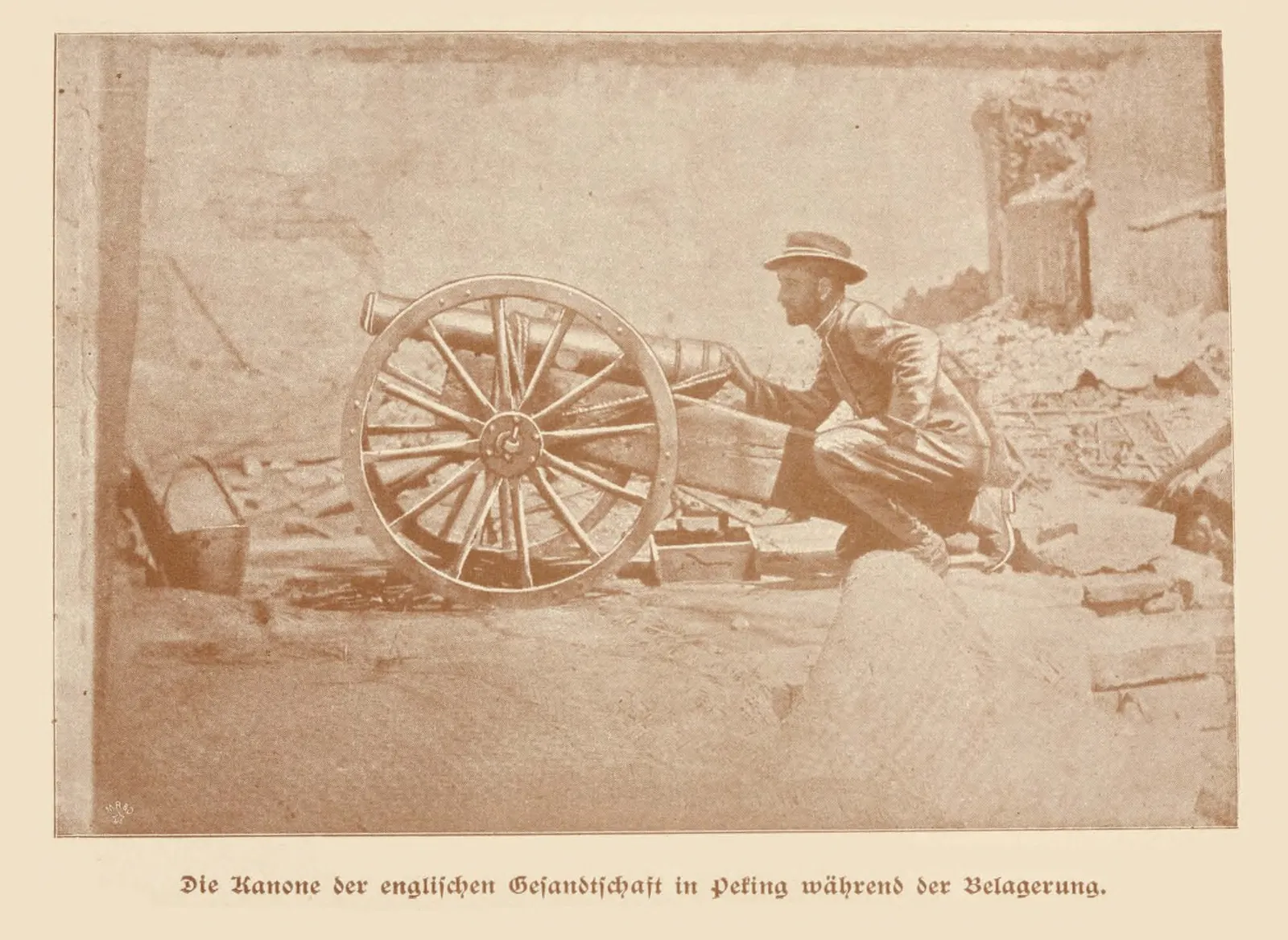
On 7 July 1900, a group of Chinese Christian refugees foraging through an iron foundry and junk shop inside the defended perimeter unearthed a heavy, encrusted bronze smoothbore cannon barrel half-buried in dirt and scrap metal. Examining the markings on the trunnions, British officers concluded that the barrel was an old British muzzle-loading royal mortar or field piece dating back to the Anglo-French expedition of 1860 during the Second Opium War—or a Chinese imperial casting patterned directly on one.
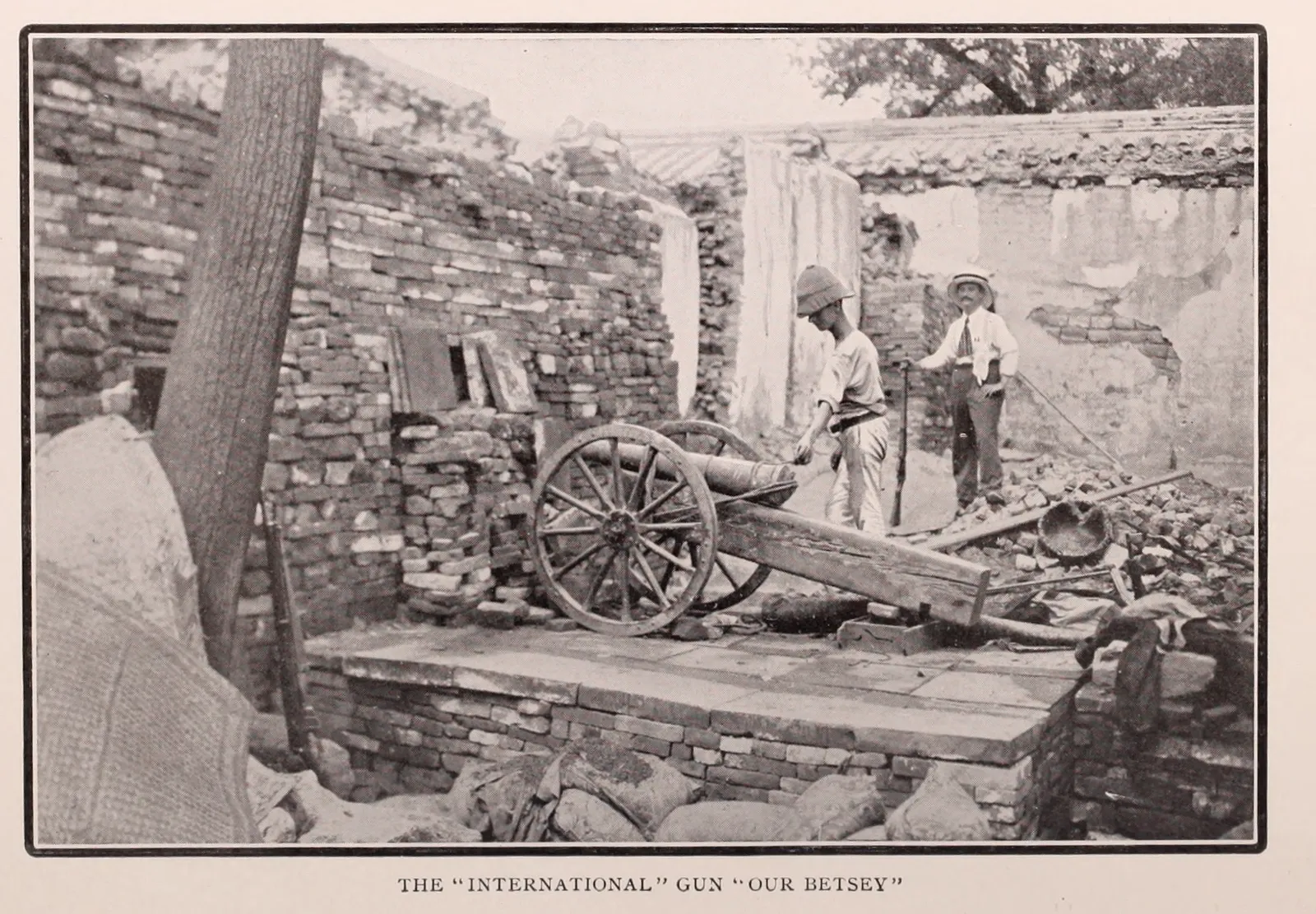
The man who turned that rusted bronze tube into a working siege weapon was U.S. Navy Gunner’s Mate First Class Joseph A. Mitchell of the cruiser USS Newark, assisted by Welsh armourer Thomas James of HMS Orlando. Scraping forty years of rust from the bore and drilling clear the plugged touchhole, Mitchell lashed the British barrel onto a spare wooden gun carriage belonging to the Italian legation’s 1-pounder, securing it with heavy iron brackets and wire cable. When the crew fished the abandoned Russian 9-pounder shells out of the legation well and filed down their copper driving bands, they discovered that the three-inch Russian projectiles slid neatly down the British muzzle.
Firing “Old Betsy” Across the Barricades
Because every component belonged to a different country, the defenders immediately christened the weapon the “International Gun”—though the American Marines affectionately dubbed her “Old Betsy” and “The Empress Dowager.” Her pedigree was a diplomatic alliance in miniature: a British barrel discovered by Chinese Christians, lashed to an Italian carriage, loaded with modified Russian shells, packed with German and Japanese black powder sewn into silk bags made from legation curtains, and aimed and fired by an American sailor.
Firing Old Betsy was nearly as hazardous to her crew as to the enemy. Having no recoil buffers, the makeshift cannon leaped six to eight feet backward at every discharge, threatening to tear the Italian carriage apart unless sandbags and timber wedges were piled behind the wheels. When the supply of Russian shells ran low, legation missionaries and mechanics melted down silver candlesticks and pewter teapots in makeshift crucibles to cast homemade canister shot and solid balls. Yet at ranges of thirty to a hundred yards in the narrow hutongs around the Suwangfu and Mongol Market, Old Betsy’s thunderous roar, billowing cloud of black smoke, and heavy three-inch projectiles blew apart Qing brick breastworks and convinced Imperial commanders that the foreigners possessed heavy siege artillery. During a ferocious attack on the French legation on 12 July, Gunner Mitchell manhandled the cannon under heavy rifle fire to shatter an advancing Chinese barricade—an action for which he was later awarded the Medal of Honor.
The Defence and the Relief of 14 August
Behind the foreign marines stood the indispensable labour of the nearly 3,000 Chinese Christians and the separate garrison at the Peitang (North Cathedral), where Bishop Pierre-Marie-Alphonse Favier, forty-three French and Italian sailors, and Chinese Catholic militiamen held out against even heavier mining and bombardment. Inside the Legation Quarter, Chinese volunteers under engineering missionary Frank Gamewell filled tens of thousands of silk and satin sandbags, dug counter-mine trenches to intercept Qing gunpowder tunnels, and rebuilt shattered walls every night under sniper fire.
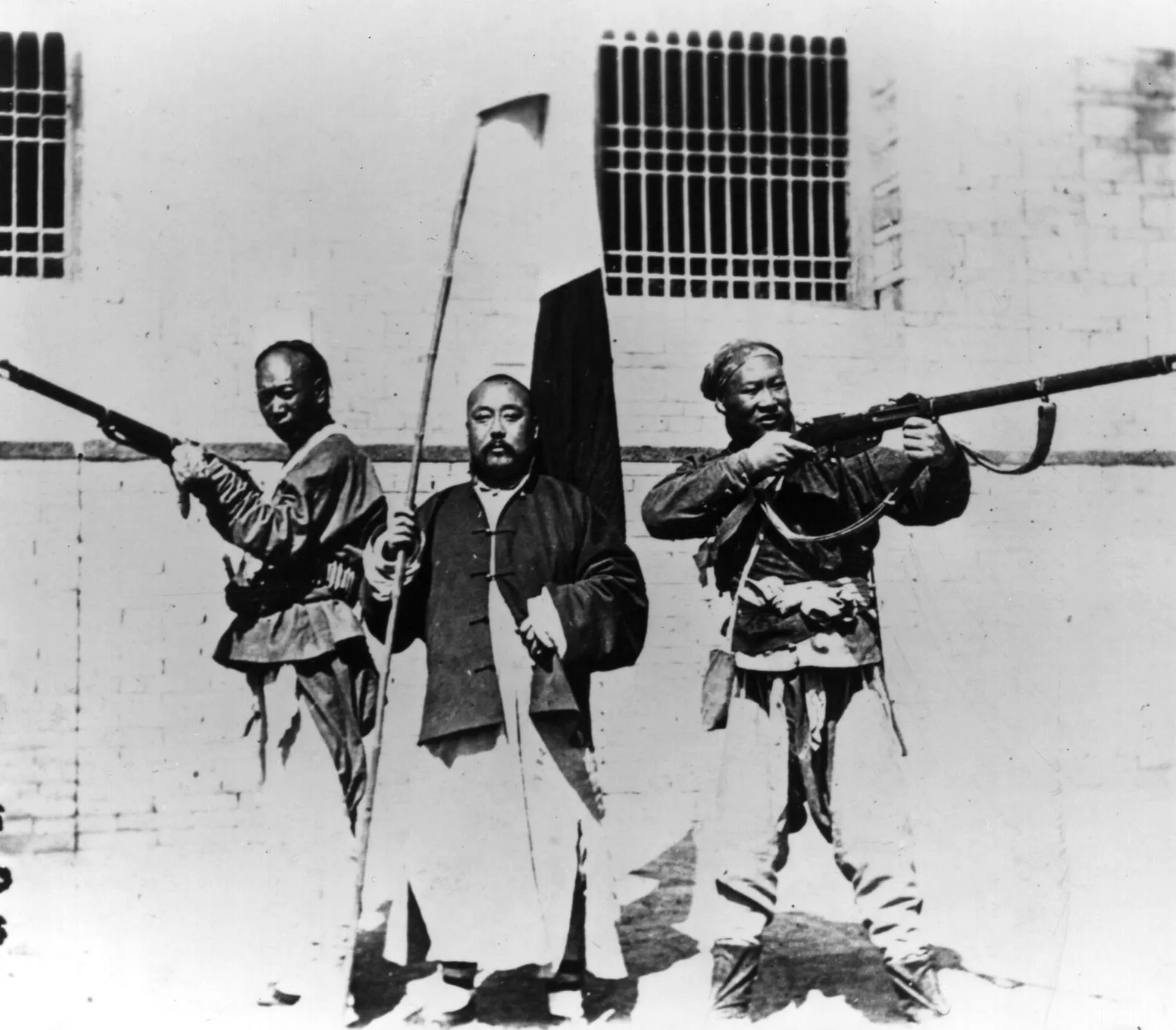
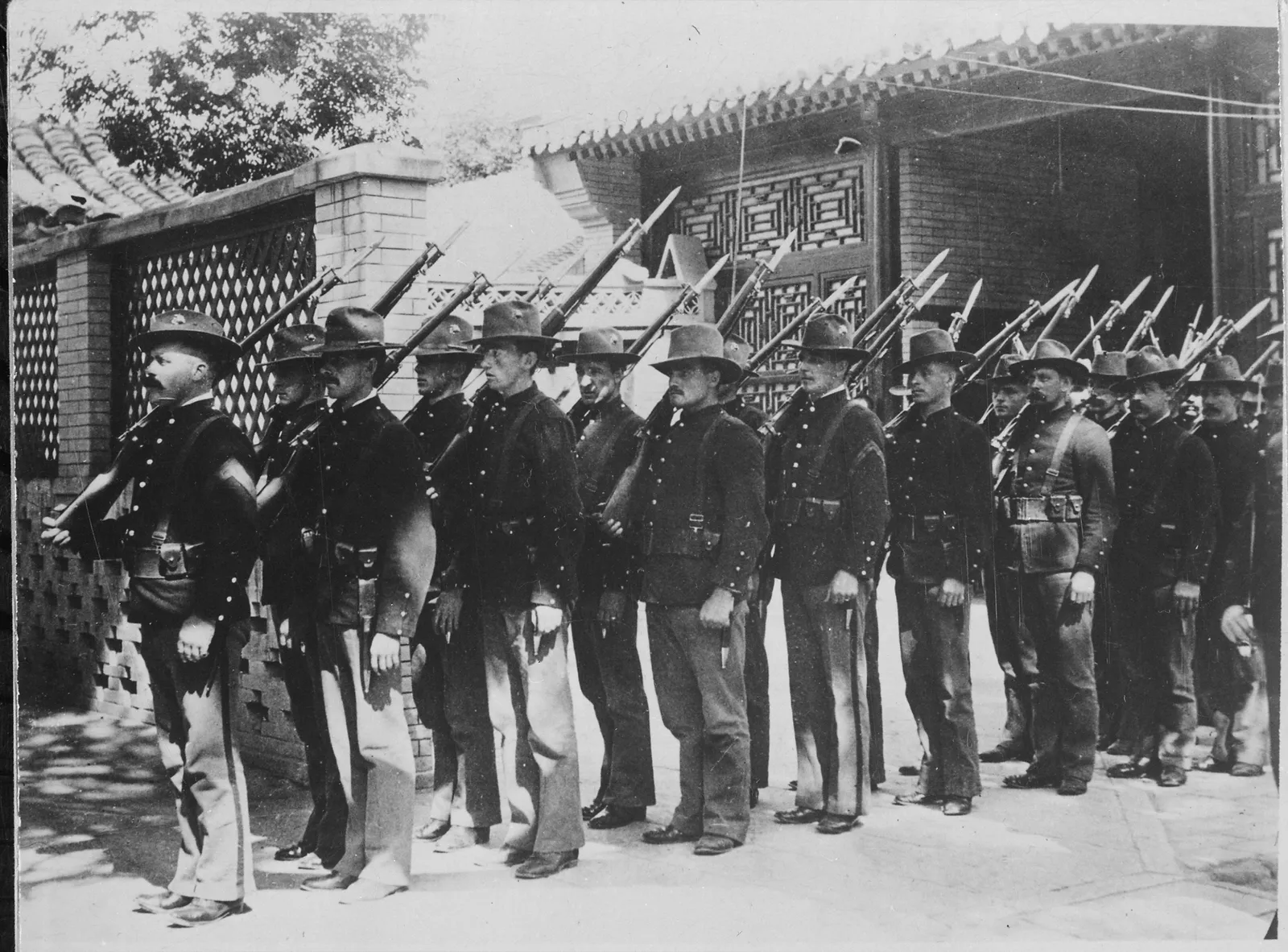
The human cost of the fifty-five-day siege was severe: out of 409 foreign legation guards, 55 were killed and 135 wounded—a military casualty rate of 46.5 percent—alongside 13 foreign civilians killed and dozens of Chinese Christians lost to gunfire, mines, and privation. On the afternoon of 14 August 1900, the 20,000-strong Gaselee Expedition of the Eight-Nation Alliance reached Peking. Guided by a message passed through the lines, British-led 1st Sikh Infantry and 7th Rajput Infantry regiments crept through the iron sluice of the unguarded Water Gate beneath the Tartar Wall and emerged onto the British Legation lawn at 3:00 p.m., followed closely by the American 14th Infantry scaling the wall itself.
Where the Gun Is Now
After the relief of Peking, the allied commanders agreed that Old Betsy belonged to the United States Navy in recognition of Gunner Joseph Mitchell’s heroism. Transported across the Pacific, the International Gun was placed on permanent exhibition at the United States Naval Academy Museum in Annapolis, Maryland, where the scarred 1860 bronze barrel still rests on its improvised carriage—an enduring physical relic of desperate battlefield improvisation.
What the Record Shows
8 sourced claims in this story, resting on 6 primary and historical records. Numbers link to the bibliography below.
- The Siege of the International Legations in Peking lasted 55 days, from June 20 to August 14, 1900 - sources: 1, 2
- Over 900 foreign personnel and nearly 3,000 Chinese Christians were besieged without heavy artillery - sources: 1, 3
- Chinese Christian refugees found an abandoned 1860 British bronze cannon barrel in an iron junk shop - sources: 2, 4
- U.S. Navy Gunner Joseph Mitchell mounted the barrel on an Italian gun carriage using cable and brackets - sources: 1, 4
- The gun fired modified Russian three-inch shells using German powder charges and American gunners - sources: 1, 2
- The cannon was dubbed the ‘International Gun’, ‘Old Betsy’, and ‘The Empress Dowager’ by defenders - sources: 1, 5
- Gunner Joseph Mitchell was awarded the Medal of Honor for his artillery heroics during the siege - sources: 4, 6
- The improvised cannon survived the siege and is preserved at the U.S. Naval Academy Museum in Annapolis - sources: 1, 5
Archival Evidence & Picture Credits
Every image on this page was checked against its Wikimedia Commons file page.
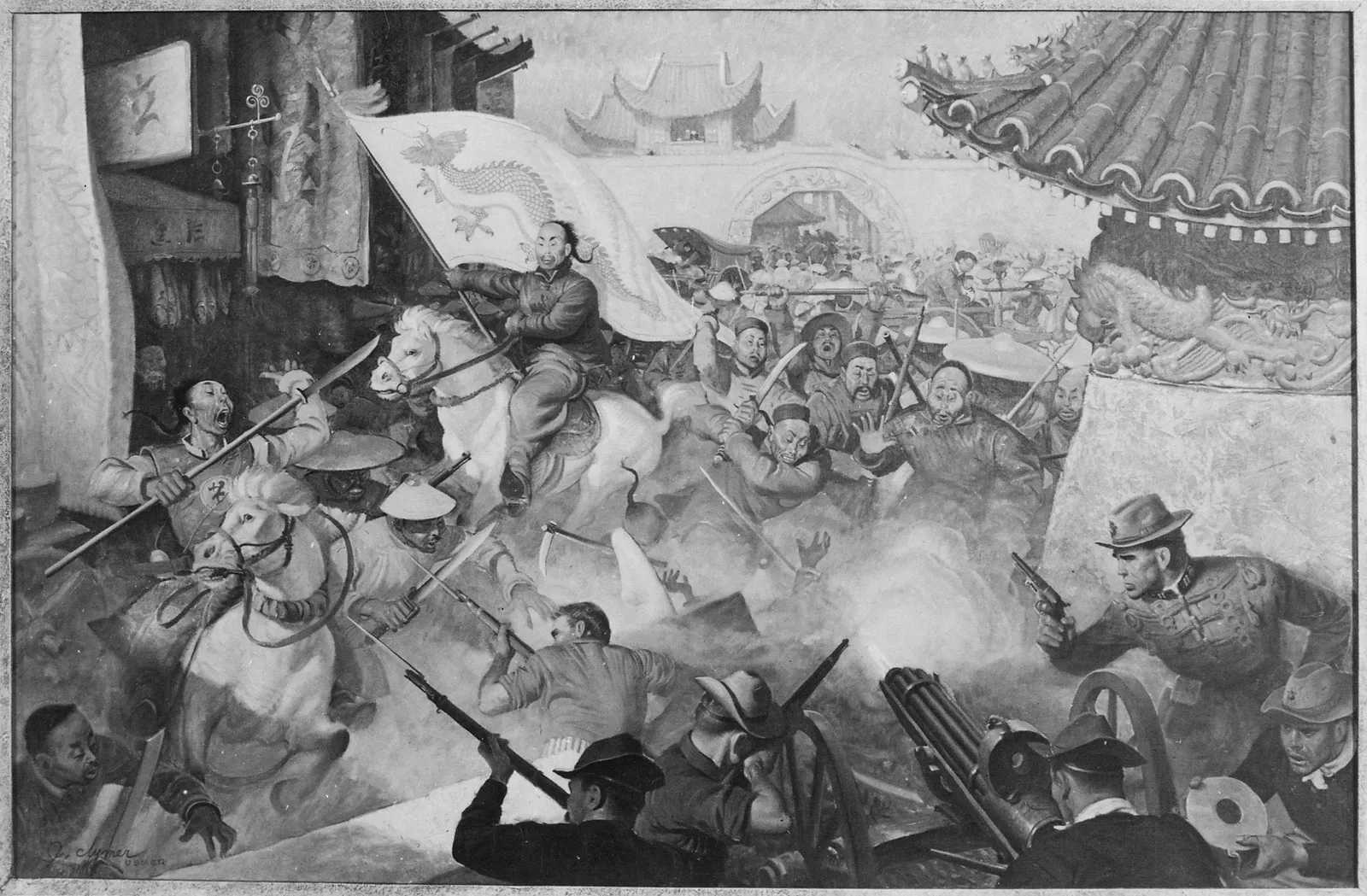
- U.S. Marines fighting Boxers outside the Peking Legation in 1900, from a painting by Sergeant John Clymer (National Archives / Wikimedia Commons) - Wikimedia Commons file page
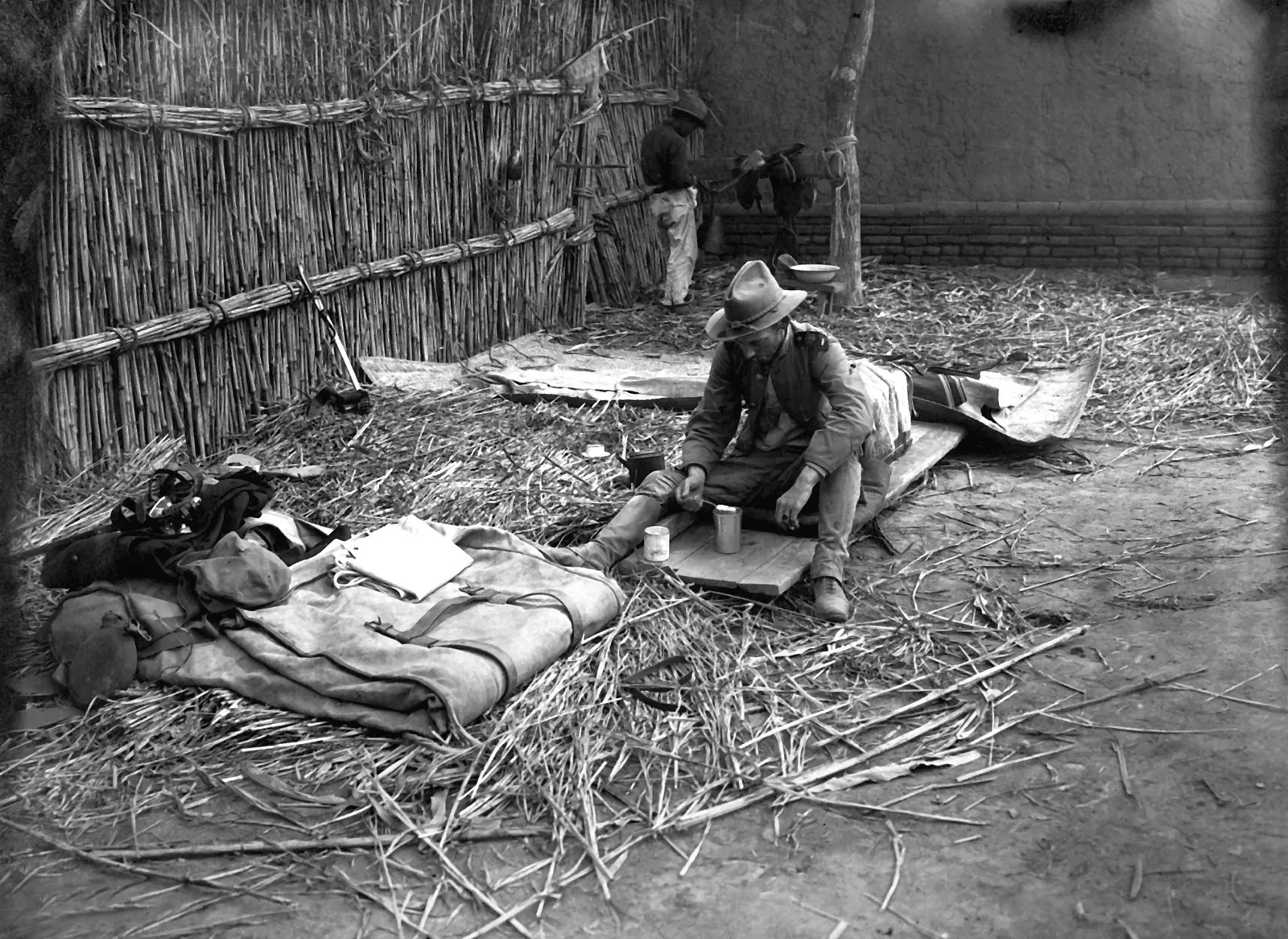
- Sandbagged American military quarters in the Legation Quarter during the Boxer Rebellion (Wikimedia Commons) - Wikimedia Commons file page
- The cannon at the British Legation in Peking during the siege (Wikimedia Commons) - Wikimedia Commons file page
- The International Gun, known as Betsey, with its gun crew (Wikimedia Commons) - Wikimedia Commons file page
- Chinese Catholic militiamen prepared to defend the Peking perimeter during the Boxer Rebellion in 1900 (Wikimedia Commons) - Wikimedia Commons file page
- U.S. Marines in the relief party at Peking, China, in 1900 (National Archives / Wikimedia Commons) - Wikimedia Commons file page


Verified Archival Sources & Bibliography
Every claim in this account has been fact-checked against primary archives and scholarly repositories:
- Wikipedia: International Gun & Siege of the International Legations (reference)
- Internet Archive: The Siege at Peking (Peter Fleming) (book)
- The International History Review: The Boxer War and the Siege of the Legations (academic)
- Naval History and Heritage Command: The Boxer Rebellion and U.S. Navy Bluejackets (primary)
- U.S. Naval Academy Museum: The International Gun ‘Old Betsy’ Catalog Record (primary)
- Congressional Medal of Honor Society: Gunner Joseph A. Mitchell Citation (primary)
Historical Connection Graph
A City's Greatest Minds Let Lice Drink Their Blood to Survive the Nazis
AJ. "They Built a Cannon Out of Five Nations' Junk to Survive a 55-Day Siege." Echoes of History Uncut. Last modified September 20, 2026. https://echoesofhistoryuncut.com/articles/peking-international-gun-1900/.

An independent digital history publication and documentary studio reconstructing historical turning points through primary archives, official inquiries, and scholarly citations. Every factual claim in this dossier is cross-referenced to the numbered bibliography above.