
A Lost Airliner Landed on a Racecourse Lit by Car Headlights
In October 1934, KLM's DC-2 'Uiver' was racing from England to Melbourne when an electrical storm cut its radio and left it lost over Albury, New South Wales. The town flashed its street lights in Morse code, a local ABC radio announcer asked people to drive to the racecourse, and their headlights lit a runway. The Uiver landed safely, sank into the mud, and was dug out at daybreak by 300 townspeople - then flew on to win the race's handicap prize.
In this dossier (13 chapters) ▾
- 01 The Great Air Race
- 02 The Final Leg
- 03 A Town Switches Its Lights
- 04 Out of the Mud
- 05 Why There Was a Race
- 06 The Comet, the Uiver and the Boeing
- 07 Thanks From KLM
- 08 The Result
- 09 The End of the Uiver
- 10 Remembered in Albury
- 11 What the Record Shows
- 12 Archival Evidence & Picture Credits
- 13 Verified Archival Sources & Bibliography
Historical Dossier: The Uiver and the Albury Landing Location: Albury, New South Wales, Australia | Year: 20–24 October 1934 | Key Figures: Captain Koene Dirk Parmentier, First Officer Jan Moll, Bouwe Prins, Cornelis van Brugge, Lyle Ferris
The Great Air Race
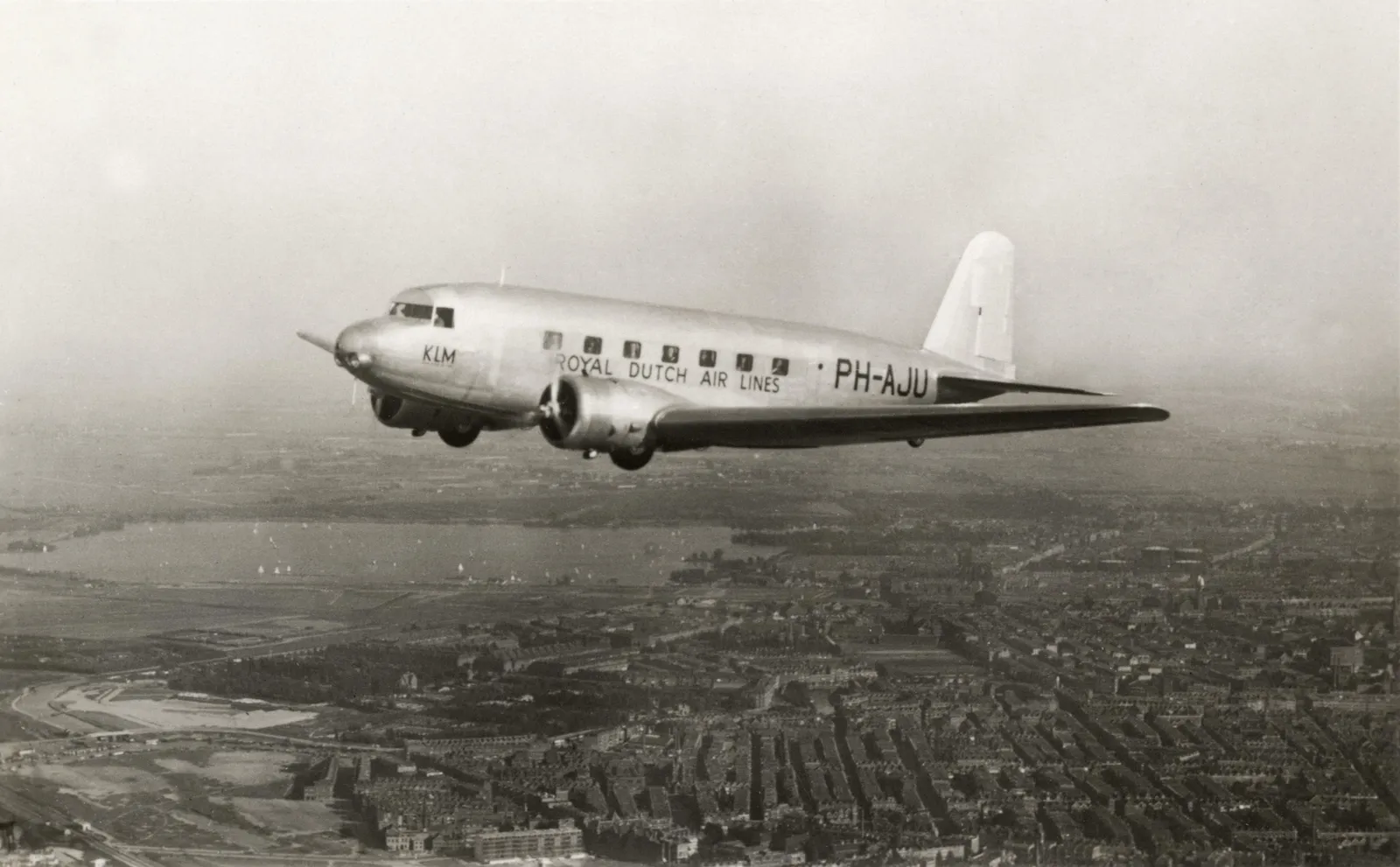
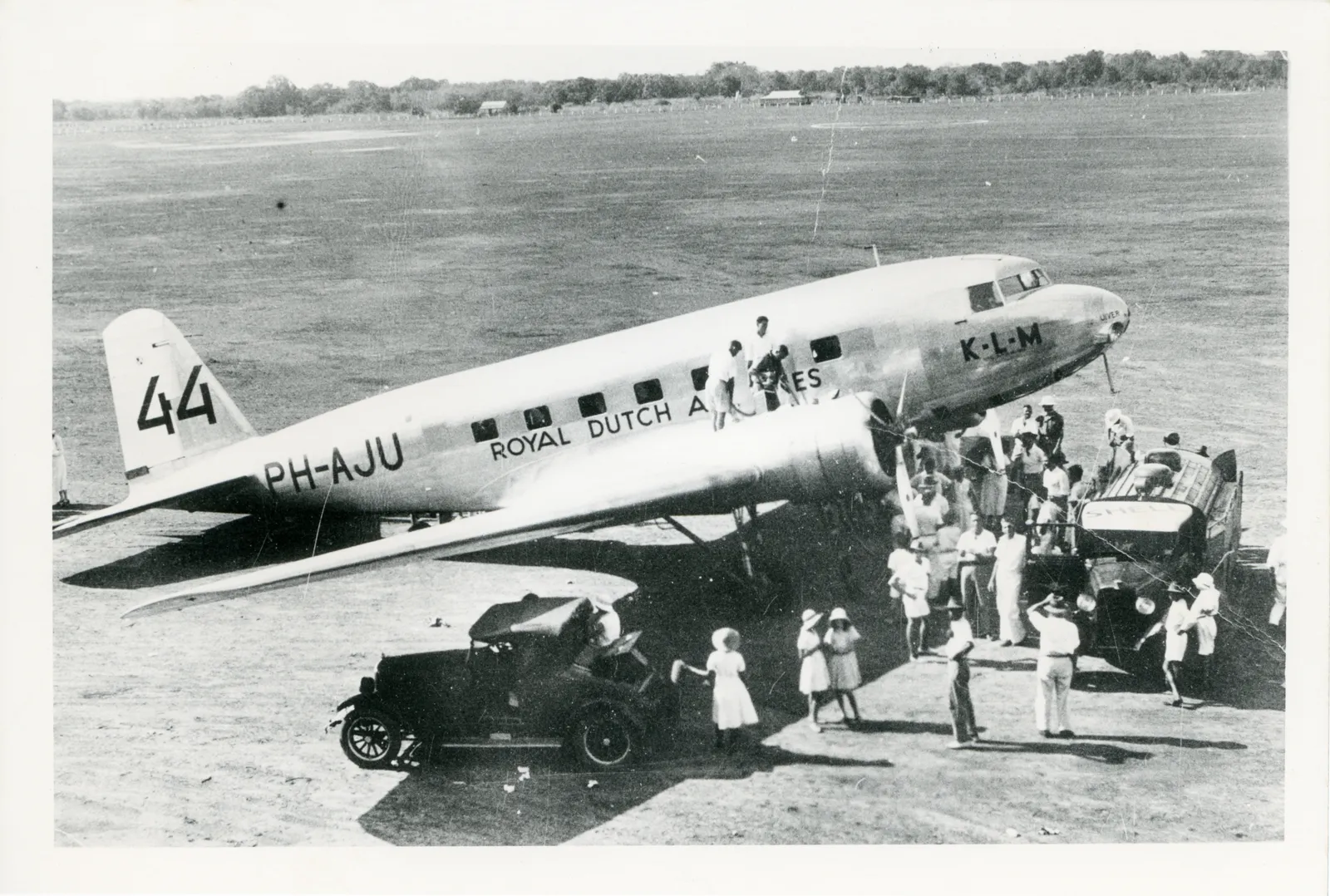
In October 1934 an air race from Mildenhall in England to Melbourne in Australia, the MacRobertson Air Race, was held to mark the centenary of the state of Victoria. It ran from 20 to 24 October. Among the entries was an unusual one: a Douglas DC-2 airliner of the Dutch airline KLM, registered PH-AJU and named Uiver, the Stork. It was not a racing aeroplane. It was an airliner that carried three passengers and mail.
The crew was Captain Koene Dirk Parmentier, First Officer Jan Moll, the flight engineer Bouwe Prins and the radio operator Cornelis van Brugge.
The Final Leg
The Uiver flew the last leg from Charleville, in Queensland, towards Melbourne. Then the weather turned. A huge storm blew up, and the aircraft was lost in the dark.
A Town Switches Its Lights
The crew was in trouble: lost, low on visibility, and with the night and the storm around them. Below them was the town of Albury, in New South Wales. Lyle Ferris, the chief electrical engineer of the post office, went to the power station and signalled “A-L-B-U-R-Y” to the aircraft in Morse code by switching the town’s street lights on and off. The crew knew where they were.
But there was nowhere to land. The only place large enough was the racecourse, and it was dark and soaked with rain. The people of Albury lined up about 70 cars around the field, with their headlights on, to light a makeshift runway.
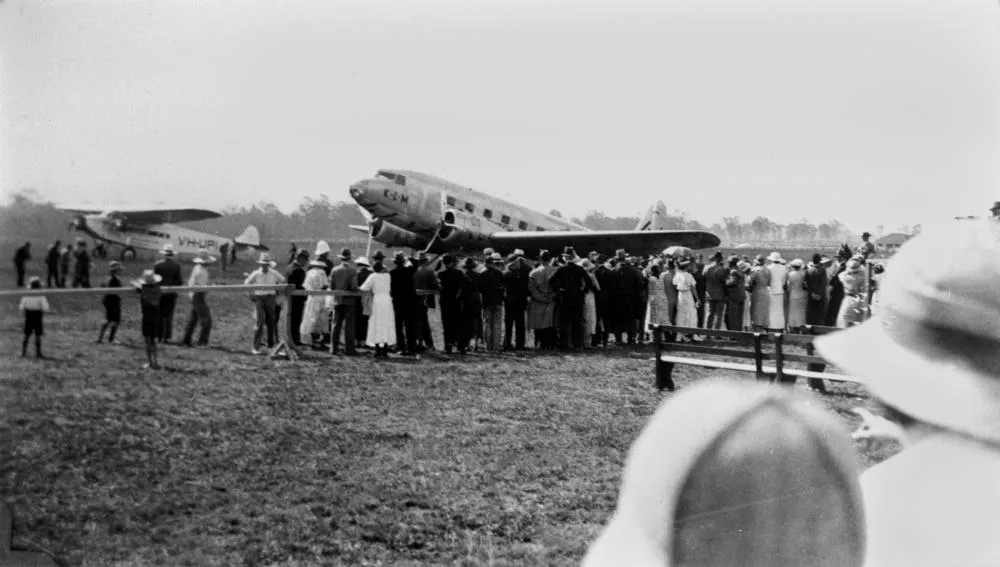
At 1:20 in the morning of 24 October 1934, Parmentier landed the DC-2 on the inner field of the racecourse. The ground was saturated and the aircraft was deeply bogged, but it was safe.
Out of the Mud
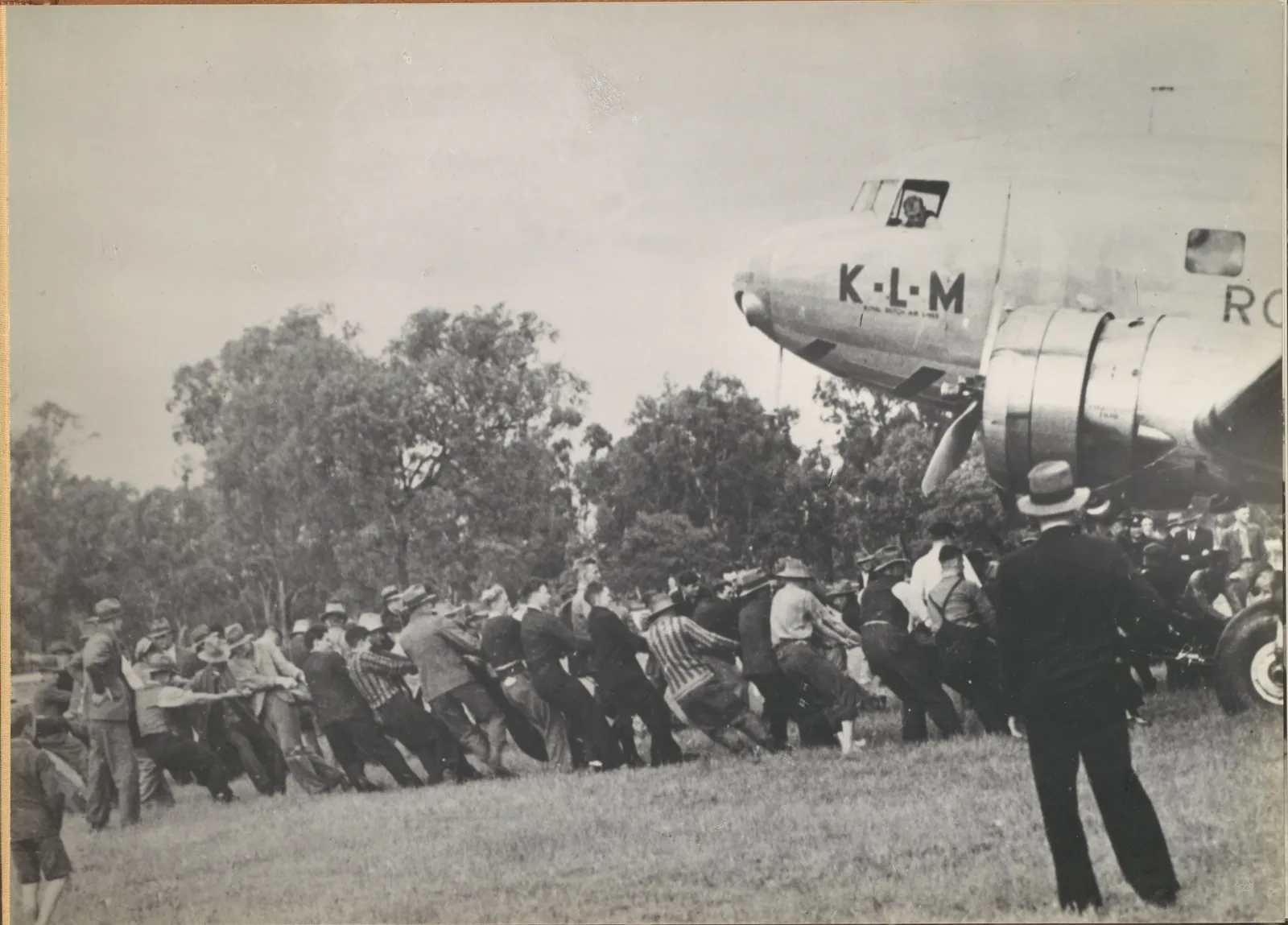
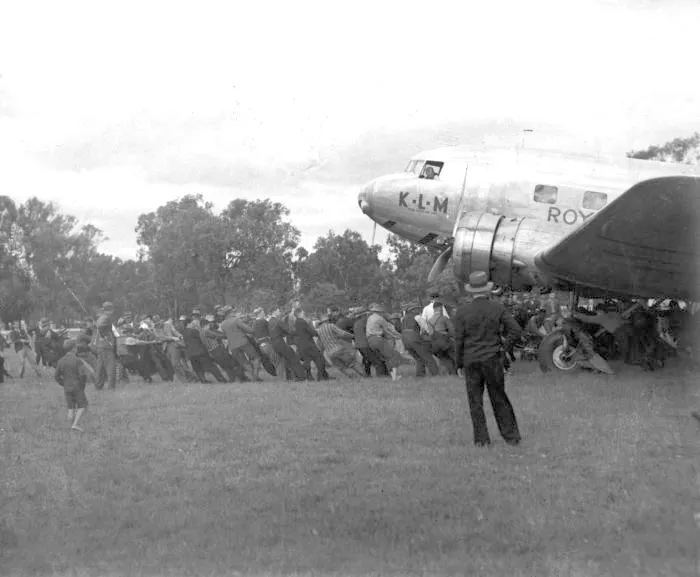
The next morning the townspeople pulled the Uiver out of the mud. A large group of men took hold of a rope and hauled the plane free. The aircraft was stripped of all excess weight, and only Parmentier and Moll went on board, and it took off and flew on to Melbourne.
Why There Was a Race
The race was devised to mark the centenary of the state of Victoria. Sir Harold Gengoult Smith, the Lord Mayor of Melbourne, came up with the idea, and Sir Macpherson Robertson, a wealthy Australian confectionery manufacturer, put up the prize money. His conditions were that the race be named after his MacRobertson company, be run with the maximum safety precautions, and that “a gold medal be awarded to each pilot who completed the course within 16 days.”
The route ran about 11,300 miles from RAF Mildenhall in East Anglia to Flemington Racecourse in Melbourne, with compulsory stops at Baghdad, Allahabad, Singapore, Darwin and Charleville in Queensland. The Royal Aero Club ran the race, with speed and handicap prizes worth £15,000 in total.
More than 60 aircraft had been entered, but only 20 were ready by the start. At dawn, 6:30 a.m. on 20 October 1934, some 60,000 spectators watched them leave Mildenhall. The field included three purpose-built de Havilland DH.88 Comet racers, two American all-metal airliners, and a range of older racers and bombers.
The Comet, the Uiver and the Boeing
The Comet Grosvenor House, flown by Flight Lieutenant C. W. A. Scott and Captain Tom Campbell Black, won in less than three days, in about 71 hours. It would also have taken the handicap prize, but the rules said that no aircraft could win more than one prize.
That left the handicap to the second aircraft home, the KLM Douglas DC-2 Uiver, which took about 90 hours, “flying a regular route with passengers.” Sources give its time as 90 hours 13 minutes or 90 hours 17 minutes. The American entry, a Boeing 247D flown by Roscoe Turner with Clyde Pangborn and Reeder Nichols, was third in 92 hours 55 minutes. Both were commercial airliners, and the result showed that airliners could compete with purpose-built racing machines.
The race had its tragedies. A Fairey Fox flown by H. D. Gilman and J. K. Baines crashed near Palazzo San Gervasio in Italy and killed both men. Only ten aircraft were classified as finishers.
Thanks From KLM
KLM was grateful. It gave a substantial donation to the Albury District Hospital, and the Mayor of Albury, Alf Waugh, received the Dutch Order of Orange-Nassau.
The Result
The Uiver completed the 19,877 kilometres in about 90 hours, with sources giving 90 hours 13 minutes or 90 hours 17 minutes. It won the handicap division, a category designed to give slower aircraft a fair chance against the fastest. It finished second overall, behind the de Havilland Comet flown by C. W. A. Scott and Tom Campbell Black.
The End of the Uiver
The aircraft’s career was short. On 20 December 1934 the Uiver left Schiphol for Batavia with Christmas mail. Captain Willem Beekman is said to have refused at first to leave Cairo because of the weather, but allegedly faced the threat of dismissal from the director of KLM, Albert Plesman. The plane crashed near Rutbah, in Iraq, and all seven on board were killed, four crew and three passengers, among them the newspaper owner Dominique Willem Berretty and the medical professor Eduard Willem Walch.
Remembered in Albury
The town of Albury has remembered the Uiver ever since. A replica DC-2 flew the Melbourne route again in 1983 and 1984, and it is now at the Aviodrome museum in Lelystad. A replica statue of the Uiver was given to Albury by Amsterdam in 2020. In October 2019 an exhibition marked the 85th anniversary of the landing.
The landing is remembered in the Netherlands and in Australia because it was a case of strangers helping strangers. A Dutch crew, lost in a storm over a country they did not know, found a town that turned on its lights and its car headlights, and a race that was about speed was won, in the end, by kindness.
What the Record Shows
10 sourced claims in this story, resting on 10 sources. Numbers link to the bibliography below.
- In 1934, townspeople in Albury, Australia dug the bogged Dutch airliner Uiver out of the mud and hauled it to firmer ground - sources: 1, 2
- The Uiver, a Dutch KLM airliner, took off from Mildenhall, England, in the 1934 air race to Melbourne - sources: 1
- A fierce electrical storm cut the Uiver’s wireless contact and the plane became lost - sources: 1, 2, 5
- Albury’s town lights were flashed to spell out Albury in Morse code for the lost plane - sources: 1, 4, 6
- Arthur Newnham of the local ABC radio station broadcast an appeal for people to take their cars to the Albury racecourse - sources: 1, 4, 3
- Cars lined up at the Albury racecourse and their headlights lit a landing strip for the Uiver - sources: 2, 1, 7, 8
- The Uiver landed safely at the racecourse and then became bogged in the mud - sources: 1, 3
- At daybreak the townspeople of Albury dug the bogged Uiver out - sources: 1, 2
- The Uiver resumed its flight to Melbourne and won the handicap section of the race - sources: 1
- Albury’s townspeople lined up their cars and used their headlights to light a makeshift runway for the Uiver - sources: 2, 7, 1
Archival Evidence & Picture Credits
Every image on this page was checked against its Wikimedia Commons file page.
- The KLM Douglas DC-2 PH-AJU, the Uiver, winner of the handicap race to Melbourne in 1934 (Wikimedia Commons) - Wikimedia Commons file page
- Parmentier and Moll of KLM at Archerfield Aerodrome for the Melbourne Centenary Air Race, 1934 (State Library of Queensland / Wikimedia Commons) - Wikimedia Commons file page
- The KLM DC-2 Uiver at Darwin during the MacRobertson Air Race, 1934 (Wikimedia Commons) - Wikimedia Commons file page
- Men pulling the Uiver out of the mud at Albury, October 1934 (Rijksmuseum / Wikimedia Commons) - Wikimedia Commons file page
- A large group of men pulling the aeroplane De Uiver from the mud on a rope at Albury (Tropenmuseum / Wikimedia Commons) - Wikimedia Commons file page
- The Uiver crew being honoured after completing the race to Melbourne, 30 November 1934 (Wikimedia Commons) - Wikimedia Commons file page


Verified Archival Sources & Bibliography
Every claim in this account has been fact-checked against primary archives and scholarly repositories:
- AlburyCity: The Uiver (primary)
- ABC News: Dutch airliner Uiver’s emergency landing at Albury 85 years ago commemorated (news)
- ABC News: Children’s book recounts Albury saving Uiver (news)
- ABC News: Albury residents celebrate efforts to save DC-2 KLM plane (news)
- Uiver Memorial: The Uiver Story (primary)
- Fly Albury: The Uiver Story (primary)
- Monument Australia: Uiver Memorial (primary)
- Denzil Howson Archive: The Flight of the Uiver (primary)
Historical Connection Graph
Six Cars Raced From New York to Paris in 1908. It Took 169 Days.
AJ. "A Lost Airliner Landed on a Racecourse Lit by Car Headlights." Echoes of History Uncut. Last modified September 30, 2026. https://echoesofhistoryuncut.com/articles/uiver-albury-headlights-1934/.

An independent digital history publication and documentary studio reconstructing historical turning points through primary archives, official inquiries, and scholarly citations. Every factual claim in this dossier is cross-referenced to the numbered bibliography above.